
How long is a running track? Track dimensions explained
A running track is 400 metres long, with two 84.39 metre straights and two bends of 36.50 metres radius, each set to within 5 millimetres under SAPCA's 2021 athletics code.
4.6 from 22 Google reviews
- Lap
- 400 m
- Straights
- Two of 84.39 m
- Bend radius
- 36.50 m
- Tolerance
- Plus or minus 5 mm
- Lanes on the standard track
- Six
- Lane width
- 1.22 m, within 0.01 m
How long is a running track?
A standard running track is 400 metres long, and SAPCA’s 2021 athletics code sets its geometry as two straights of 84.39 metres and two bends with a radius of 36.50 metres (SAPCA, 2021).
Each of those figures is held to within 5 millimetres either way, so a track built to the standard has almost no room for error in its shape (SAPCA, 2021).
Standard 400 m track geometry in SAPCA’s code of practice for athletics tracks (SAPCA, 2021).
| Measurement | SAPCA’s figure |
|---|---|
| Lap length | 400 m |
| Straights | Two, each 84.39 m, within plus or minus 5 mm |
| Bends | Two, each with a radius of 36.50 m, within plus or minus 5 mm |
| Lanes on the standard track | Six |
Are all tracks 400 meters?
The 400 metre track is the standard one, the track SAPCA’s 2021 code sets out in detail, with six lanes (SAPCA, 2021).
A school or club without room for a full loop can still put down a straight sprint track or a jump runway on its own, and our athletics facilities page covers the jumps. Ask us which layout fits the space you have.
How many lanes does a running track have?
Six and eight lanes are the two running track layouts Sport England’s 3Q2026 cost guide prices, and SAPCA’s 2021 athletics code describes the standard 400 metre track with six lanes (Sport England, 2026; SAPCA, 2021).
Two more lanes make a wider track and a bigger build, and the next section puts Sport England’s figure on the difference.
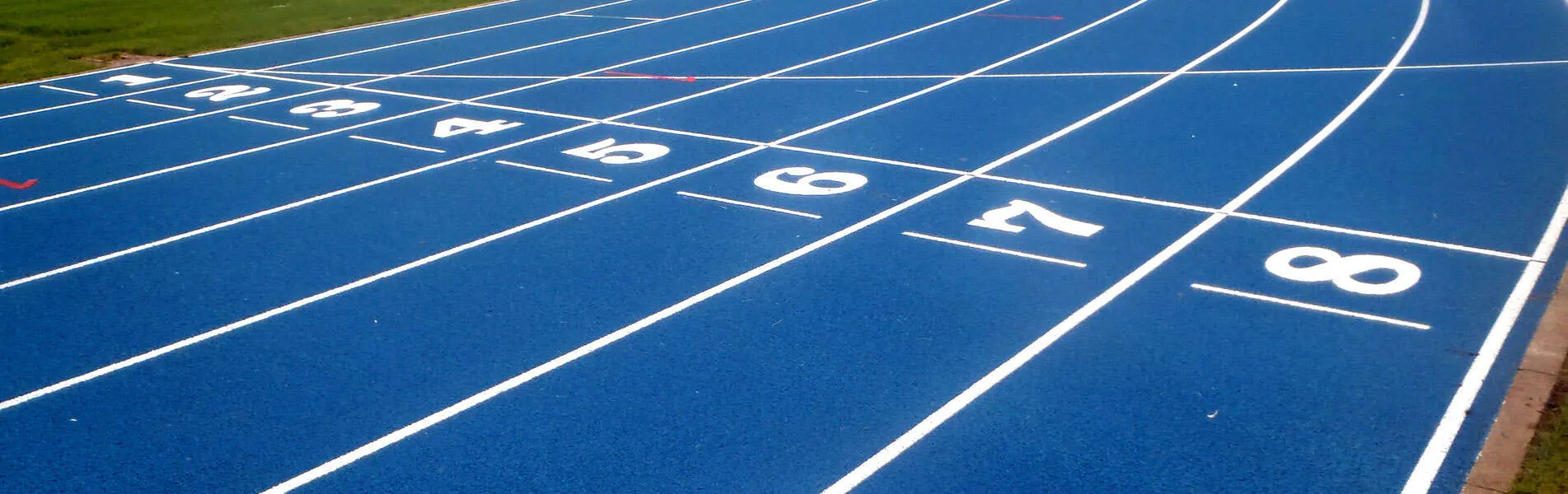
Each lane is 1.22 metres wide, within 0.01 metres either way, including the 50 millimetre line on its outside, and tracks built before 1 January 2004 may keep lanes of up to 1.25 metres until they are resurfaced (World Athletics, 2019).
What size of running track should we build?
The size of running track to build depends on the events and the space: SAPCA’s standard is six lanes, and on Sport England’s 3Q2026 benchmark eight lanes cost £160,000 more, at £2,015,000 against £1,855,000 excluding VAT (Sport England, 2026; SAPCA, 2021).
Sport England’s 3Q2026 benchmark by number of lanes, excl. VAT (Sport England, 2026).
| Lanes | Benchmark cost |
|---|---|
| Six, SAPCA’s standard track | £1,855,000 |
| Eight | £2,015,000 |
Both benchmark tracks come with field events and lighting, and the full benchmark is set out on our running track construction page. These are budgeting figures, and they leave out VAT, inflation after 3Q2026, poor ground, difficult access, biodiversity net gain, land and regional differences (Sport England, 2026).
We fit the size to the space on site and to the people who will use it. A competition track keeps to the standard sizes, while a recreational track at a school can be smaller and costs less, just as a long jump for a primary school can be.
Whether the extra £160,000 for eight lanes is worth it comes down to the events and the numbers you expect to run. Ask us for a site survey and we will measure what your ground can take.
Our guide to running track construction takes you through the surface systems, standards and build.
How accurate must a running track’s measurements be?
A standard running track allows almost no variation: SAPCA’s 2021 code sets its straights at 84.39 metres and its bend radius at 36.50 metres, each to within plus or minus 5 millimetres (SAPCA, 2021).
To put 5 millimetres in context, it is less than half the depth of the track surface itself, which SAPCA requires to average at least 12 millimetres (SAPCA, 2021).
The markings need the same care. We mark lane lines and staggered starts accurately, in weather-resistant paint that stays visible.
On the inside edge, a white kerb 50 to 65 millimetres high and 50 to 250 millimetres wide marks the track, and on the straights a 50 millimetre white line may take its place (World Athletics, 2019).
How much space does a running track need including run-offs?
A running track needs space beyond its own lines: World Athletics’ plan of the standard 400 metre track measures 176.910 metres long and 92.520 metres wide to the outer edge of the lanes, which form a band 9.760 metres wide along each side (World Athletics, 2019).
Its safety zones are set apart from those figures: an obstacle-free zone at least 1 metre wide must run inside the track, and one at least 1 metre wide should run outside it (World Athletics, 2019).
How much land do you need for a 400m track?
World Athletics gives no total land area for a track with its safety zones, so the land a track needs is worked out on your own site, from a survey of the ground.
The infield is large enough for all the throwing events and a standard 68 by 105 metre football pitch (World Athletics, 2019).
Frequently Asked Questions
How often is a running track certified?
SAPCA’s code calls for a track to be certified every five years, and UK Athletics’ TrackMark accreditation lasts three years (SAPCA, 2021).
Does a school need a full-size running track?
No. A recreational track does not have to be full size where the space is not there, and a smaller layout costs less, though a track for competition keeps to the standard sizes.
How thick is a running track surface?
The finished synthetic surface has to average at least 12 millimetres thick in SAPCA’s code, whichever of the four systems is laid (SAPCA, 2021). What the layers are made of is explained in our guide to what running tracks are made of.
Ask Us for a Site Survey for a Running Track
At Sports and Safety Surfaces, we measure the ground first, and a site survey shows what size of track your site can take. Our guide to running track construction covers the build that follows.
Call us on 01625 445766 or send your details through the contact page.
Get a free quote
© OpenStreetMap contributors
Need more information?