
Long jump pit and runway construction
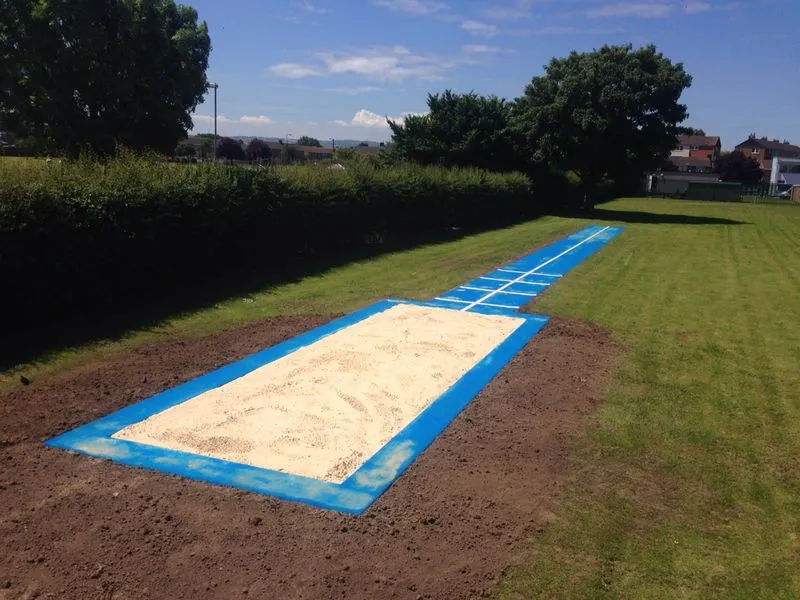
A long jump pit holds at least 300 millimetres of washed, rounded sand in a landing area 7 to 9 metres long and at least 2.75 metres wide, at the end of a 1.22 metre runway.
4.6 from 22 Google reviews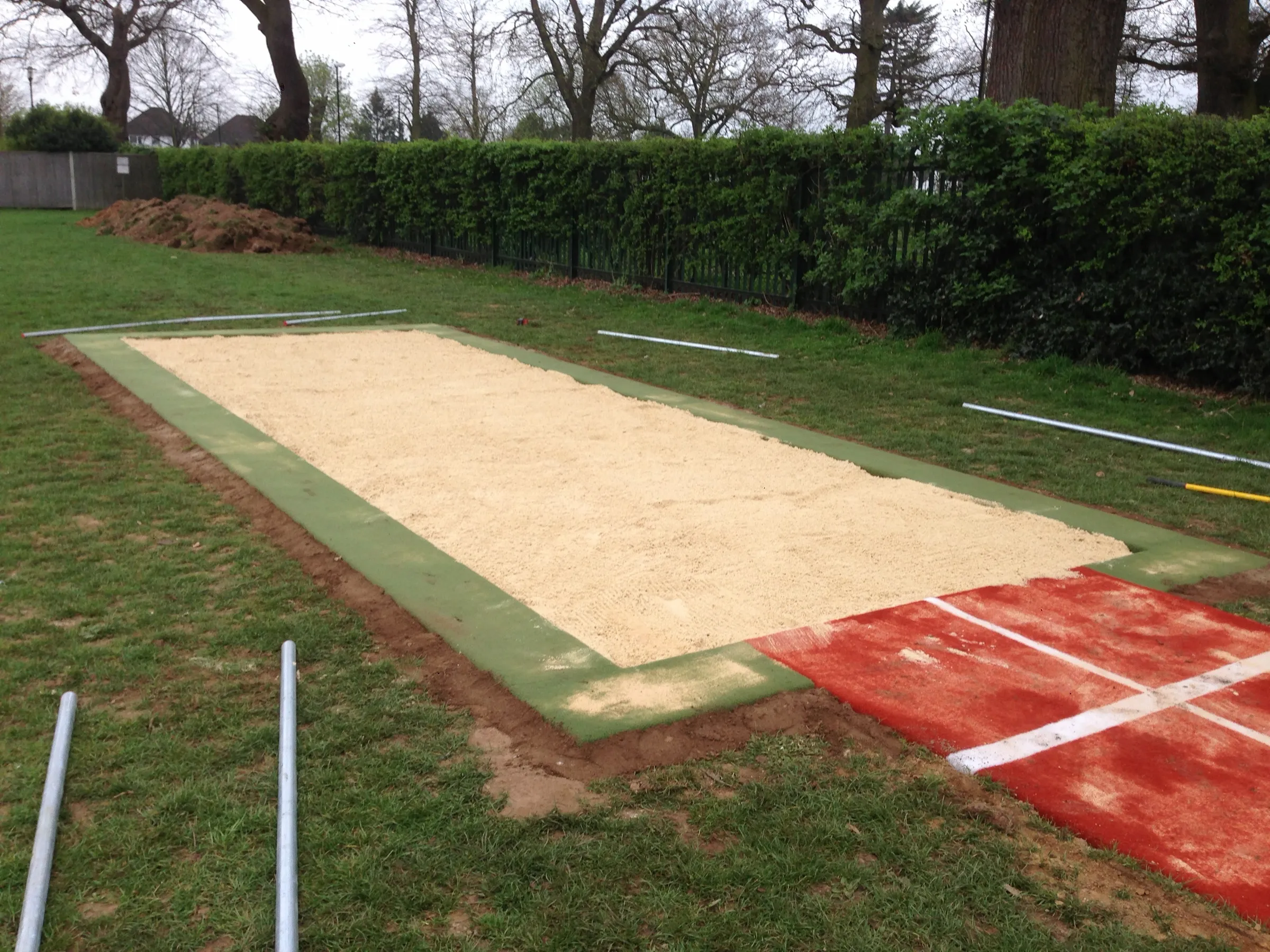
- Runway
- 1.22 m wide, at least 40 m long
- Take-off board
- 1 to 3 m from the landing area
- Landing area
- 7 to 9 m long, at least 2.75 m wide
- Board to far end
- At least 10 m
- Sand
- Washed and rounded, grains of 0.125 to 0.8 mm
- Sand depth
- At least 300 mm
What is a long jump pit and runway?
A long jump pit and runway is a run-up track 1.22 metres wide and at least 40 metres long, ending in a take-off board and a sand landing pit 7 to 9 metres long, as set out in SAPCA’s 2021 athletics code (SAPCA, 2021).
The pit does two jobs. It gives each jumper a soft landing, and it leaves a clear mark in the sand to measure the jump from.
At Sports and Safety Surfaces, we design and build runways and pits for schools, colleges, universities, leisure centres and athletics clubs. Some are new facilities built from the groundworks up, and others are old runways we repair or renovate, red shale ones included.
A runway can have one lane, two lanes or several side by side. At a school, a second lane keeps more pupils jumping in the same lesson.
White lines 50 millimetres wide mark both sides of the runway, and the landing area is at least 2.75 metres wide (SAPCA, 2021).
Which runway surface suits a school or a club?
We lay long jump runways in two surfaces: polymeric rubber, which takes running spikes and suits clubs, colleges and older athletes, and Multisport needlepunch synthetic turf, which is softer underfoot and cheaper, so it suits primary schools and recreation.
Long jump runway surfaces we lay, and who each one suits.
| Surface | What it is | Best suited to |
|---|---|---|
| Polymeric rubber | Rubber crumb bound with polyurethane, laid over macadam | Clubs, colleges, universities and older athletes; takes running spikes |
| Multisport needlepunch synthetic turf | A carpet of curly yarn fibres on a prepared base, often over a foam shockpad | Primary schools and recreation; softer for young children |
For a runway that will host competitions, we recommend polymeric rubber. Its surface falls under BS EN 14877:2013, the same British Standard as a running track’s, and our page on polymeric sports surfaces explains that family of materials.
Multisport turf is hard-wearing, and it comes in track red and other colours that resist fading in sunlight. Its curly yarn fibres do not turn slippery when wet, so it works as a practice runway all year, and it is less prone to vandalism.
Primary schools often choose turf with a different colour for each age group’s lane. Colleges tend to pair polymeric or turf with a mowing strip and rubber edges, and universities often want polymeric with removable take-off boards for the different jumps.
Red is the usual colour for polymeric, the surface many people know as tartan. Both surfaces come in other colours too, from blue or green that suits the surroundings to a rainbow of red, green, blue and yellow.
What type of sand is best for a long jump pit?
The best sand for a long jump pit is washed, rounded sand with grains of 0.125 to 0.8 millimetres, laid at least 300 millimetres deep, as SAPCA’s 2021 athletics code specifies, and we fill our pits with clean, dry silica sand of that kind (SAPCA, 2021).
Sand for a long jump landing area under SAPCA’s 2021 code (SAPCA, 2021).
| Property | SAPCA’s requirement |
|---|---|
| Type | Washed, rounded sand |
| Grain size | 0.125 to 0.8 mm |
| Depth | At least 300 mm across the landing area |
| Protection | A cover is advisable |
A school pit should always be filled with play grade sand, for the children’s safety.
Sand stays clean for longer under a cover, which SAPCA advises and which keeps leaves, litter and wind-blown dirt out between sessions (SAPCA, 2021). Our page on long jump sand pit covers explains how to choose and size one.
A purpose-made sand pit rake has a wide head that reaches across the landing area and a fibreglass handle. One person can use it to level the sand before each session and pull out weeds, stones and litter.
How much does a long jump pit and runway cost?
The cost of a long jump pit and runway is set by the runway’s length and number of lanes, its surface, the pit’s size and sand depth, the edging and extras, and the ground on site, so we price each one from a survey.
Sport England’s 3Q2026 cost guide has no separate figure for a runway and pit, because it counts the jumps inside the price of a whole athletics track (Sport England, 2026).
A primary school can keep the cost down with a smaller pit and a shorter runway, since young children will not jump as far as trained athletes. The extras are priced on top: removable take-off boards, rubber safety kerbs, a mowing strip, a shockpad under turf, and a cover and rake for the pit.
Send us the size of the space and who will use it through the contact page, and we will put together a free quote. We also give funding and budget advice, and our guide to funding for sports facilities lists the grants we have checked.
What standards must a long jump pit and runway meet?
A long jump runway’s polymeric surface falls under BS EN 14877:2013, the standard for synthetic outdoor athletics surfaces, while SAPCA’s 2021 code sets the runway, board and pit sizes and World Athletics’ facilities manual covers layout and marking (BSI; SAPCA, 2021; World Athletics, 2026).
Standards and guidance for a long jump pit and runway.
| Standard or guide | Edition | What it covers | Source |
|---|---|---|---|
| BS EN 14877 | 2013 (current, under review) | What the synthetic surface of a polymeric long jump runway has to meet | BSI |
| SAPCA code of practice: The Construction and Maintenance of Athletics Tracks | 4th edition, October 2021 | The runway’s width and length, the board’s distance from the pit, the pit’s size and its sand | SAPCA |
| World Athletics Track and Field Facilities Manual | 2019 edition for chapters 1 to 3; chapters 4 to 8 are still the 2008 edition | How a long jump runway and landing area are laid out and marked | World Athletics |
How these fit with the standards for other sports is in our guide to sports surface standards.
How is a long jump pit and runway built?
A long jump pit and runway is built on an engineered sub-base, with a polymeric runway of 12 to 13 millimetres of EPDM rubber over macadam, or needlepunch turf that we often lay over a foam shockpad, and a sand pit inside a retaining edge.
Our build runs in this order:
- Excavation and levels. We dig out to the depth the chosen surface needs and set the levels and falls, which decide how well the runway drains.
- Edging. Precast concrete edging goes round a polymeric runway and pit as standard, and timber edging round turf. Rubber kerbs can replace either, at extra cost.
- Sub-base. An engineered stone sub-base, finished in macadam under polymeric, keeps the runway flat and stable.
- Surface. Polymeric is rubber crumb mixed with a polyurethane binder and trowelled onto the macadam, as a full pour, a sandwich system or a sprayed coat over an SBR base. Turf is rolled out to shape over its base.
- Take-off point. A fixed board, a removable board or a painted white line goes in at the take-off point.
- Sand. The pit is filled with washed, rounded sand inside its edging, and a mowing strip can go round it.
A porous polymeric runway lets rain drain through, so it can be used in all weathers. Sandwich and full pour systems are sealed against water.
Under turf, a preformed foam shockpad between the sub-base and the carpet cushions each stride and landing and reduces wear on the carpet. Impact tests can measure the shockpad’s force reduction, vertical deformation and energy restitution.
Rubber safety kerbs are made from recycled tyres, usually black, and a standard kerb measures 1200 by 50 by 155 millimetres. They are softer than concrete if a child trips or falls against the edge, so we recommend them for school pits wherever the budget allows.
Ask us for a site survey to check the levels, drainage and access before the design is fixed. Specification work before a tender is covered on our sports surface consultancy page.
What are the standard length and breadth of a long jump pit?
A standard long jump pit is 7 to 9 metres long and at least 2.75 metres wide, with at least 10 metres from the take-off board to its far end, under SAPCA’s 2021 athletics code (SAPCA, 2021).
Long jump sizes in SAPCA’s code of practice for athletics tracks (SAPCA, 2021).
| Part | Size |
|---|---|
| Runway width | 1.22 m |
| Runway length | At least 40 m |
| Runway side lines | 50 mm, white |
| Take-off board to the landing area | 1 to 3 m |
| Landing area length | 7 to 9 m |
| Landing area width | At least 2.75 m |
| Take-off board to the far end of the landing area | At least 10 m |
| Sand depth | At least 300 mm |
| Runway serving landing areas at both ends | At least 58 m |
A common pit for a full-size facility is 9 by 3 metres, filled with 500 millimetres of sand. Primary schools can build smaller, because young pupils will not reach the far end of a full-size pit.
Long jump sizes we commonly build for full-size and recreational use.
| Part | Full size | Recreational or primary school |
|---|---|---|
| Runway | At least 40 m by 1.22 m, to SAPCA’s sizes | 35 m by 1.22 m, in black EPDM |
| Landing pit | 9 m by 3 m | 6 m by 3 m |
| Sand depth | 500 mm | 300 mm |
The recreational sizes fall below SAPCA’s figures, so we suggest them for PE and play, and build to SAPCA’s sizes wherever a runway will host competitions. We have built run-ups from 10 metres up to 50 metres long, depending on the budget, the space and whether the runway is for competition.
How deep does a long jump pit need to be?
A long jump pit needs sand at least 300 millimetres deep across its landing area, SAPCA’s 2021 athletics code says, using washed, rounded sand with grains between 0.125 and 0.8 millimetres (SAPCA, 2021).
Our full-size pits usually hold 500 millimetres of sand. A recreational pit for young children can stay at SAPCA’s 300 millimetres, which also needs less sand to fill.
Sand needed to fill a long jump pit (our arithmetic from the sizes on this page).
| Pit | Sand depth | Sand volume |
|---|---|---|
| 7 m by 2.75 m, SAPCA’s smallest | 300 mm | About 5.8 m³ |
| 9 m by 2.75 m | 300 mm | About 7.4 m³ |
| 9 m by 3 m, a common full size | 500 mm | 13.5 m³ |
| 6 m by 3 m, recreational | 300 mm | 5.4 m³ |
Sand is lost from an open pit over time, some of it to the wind, so we also top up the sand in existing pits.
How far is the take off board from the long jump Pit?
The take-off board sits 1 to 3 metres from the long jump pit’s landing area under SAPCA’s 2021 athletics code, which also asks for at least 10 metres from the board to the far end of the pit (SAPCA, 2021).
The two rules work together. With the board 1 metre from the pit, the landing area has to be 9 metres long to reach that 10 metres; with the board 3 metres back, 7 metres is enough, the shortest landing area SAPCA allows (our arithmetic from SAPCA’s figures).
The board fixes the point every jump is measured from and shows when a jumper has overstepped, so a runway used for competition needs one. We fit the take-off point as a fixed timber board, a removable board or, on recreational runways, a painted white line.
A fixed board is white-primed hardwood, sunk flush with the runway surface. Buy one in hardwood that has been properly sealed and painted, because boards in other timbers we have been supplied have lasted only months.
A removable board sits in a galvanised steel frame set into the ground. Its timber insert can be swapped for one topped with the runway surface on a steel plate, so the same runway can switch between long jump and triple jump.
If the white lines at the board fade, a line marking repair kit lets you restore them yourself.
Why choose Sports and Safety Surfaces for a long jump pit and runway?
Sports and Safety Surfaces designs and builds long jump runways and pits from the first survey to the finished runway and sand, and builds the high jump fans, javelin runways and throwing circles for discus, hammer and shot put that often sit beside them.
We work with each school or club on a design made to fit the space and the budget, whether that is a single lane beside a playground or a full set of jumps inside a running track.
Once a runway is in use, we keep it in condition: cleaning and repairing polymeric surfaces, topping up pit sand, and supplying covers, rakes and line marking repair kits.
Call us on 01625 445766 to talk through the space you have. The triple jump runway and pit shares this runway’s width and minimum length (SAPCA, 2021), and everything we build for athletics is on the athletics facilities page.
Frequently Asked Questions
Can one runway serve both long jump and triple jump?
Yes, with removable take-off boards set into the surface. SAPCA’s code gives both jumps the same runway, 1.22 metres wide and at least 40 metres long, and a runway with a landing area at each end needs at least 58 metres (SAPCA, 2021).
Does a long jump pit need a mowing strip?
A pit on a grass field is easier to keep clean with one. Ours are 450 millimetres wide, in concrete flags or porous rubber in any colour, red, blue, green, black and yellow among them, and the strip keeps grass cuttings and weeds out of the sand while giving officials somewhere to stand to measure.
Can a long jump runway double as a sprint track?
A 60 metre runway can. The same straight serves sprints, relays and hurdles, which gets more use out of the space at a school.
How should a long jump runway and pit be looked after?
Sweep the runway so dirt cannot settle into its pores, rake the sand level before each session and keep the pit covered in between. SAPCA’s specimen schedule for polymeric surfaces asks for a sweep at least every two weeks (SAPCA, 2021).
Get a Free Quote for a Long Jump Pit and Runway
At Sports and Safety Surfaces, we start every long jump project with a site survey to measure the space, check the ground and the levels, and talk through who will use the runway and the budget.
Call us on 01625 445766 or request a free quote through the contact page.
Testimonials
A selection of our Google reviews, posted over several years and quoted word for word. Google shows each review's date. Rating as shown on Google on 16 November 2026.
We had our 2 of our tennis courts rejuvenated by Sports and safety services June 2022. They did a great job and we are very happy with services they provided. Will use them again and would recommend to others. Pete Emsell Chairman Huddersfield Lawn Tennis and Squash club
They installed a sports track at my kids school and as a committee member we were involved in the selection process, can highly recommend these guys, top job from start to finish.
I am the secretary of our local junior football club. We needed an area the teams could train during the bad weather and not ruin the pitches.
Spoke with several companies and these were by far the most professional and answered all the questions I had, which put my mind at ease.
Now the teams have somewhere to train during the winter months which can only be beneficial to their development.
They are a really helpful company with an eye for attention to details while offering good value for money. They are keen to encourage UK commerce and go the extra mile to make sure the customer needs are met. The projects they have completed for me have all been on time and more importantly with budget!
The sports surfaces installed to the MUGAs was an amazing upgrade to the existing surfacing. I would definitely use these again on sport surfacing to ball courts in the UK
Uk sports surfaces contractor who have constructed, surfaced and maintained many sport all weather courts for us.
Get a free quote
© OpenStreetMap contributors
Need more information?