
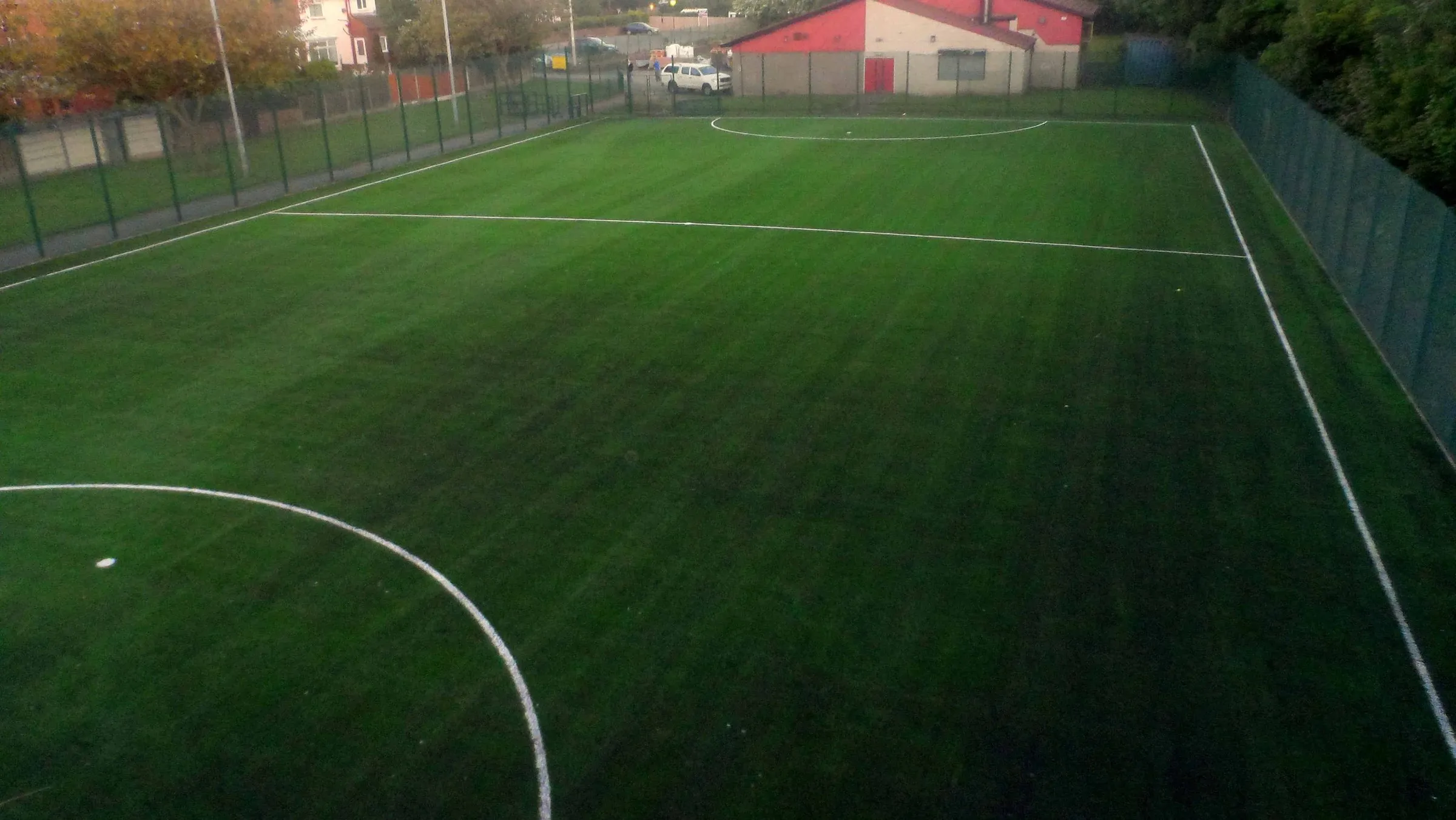
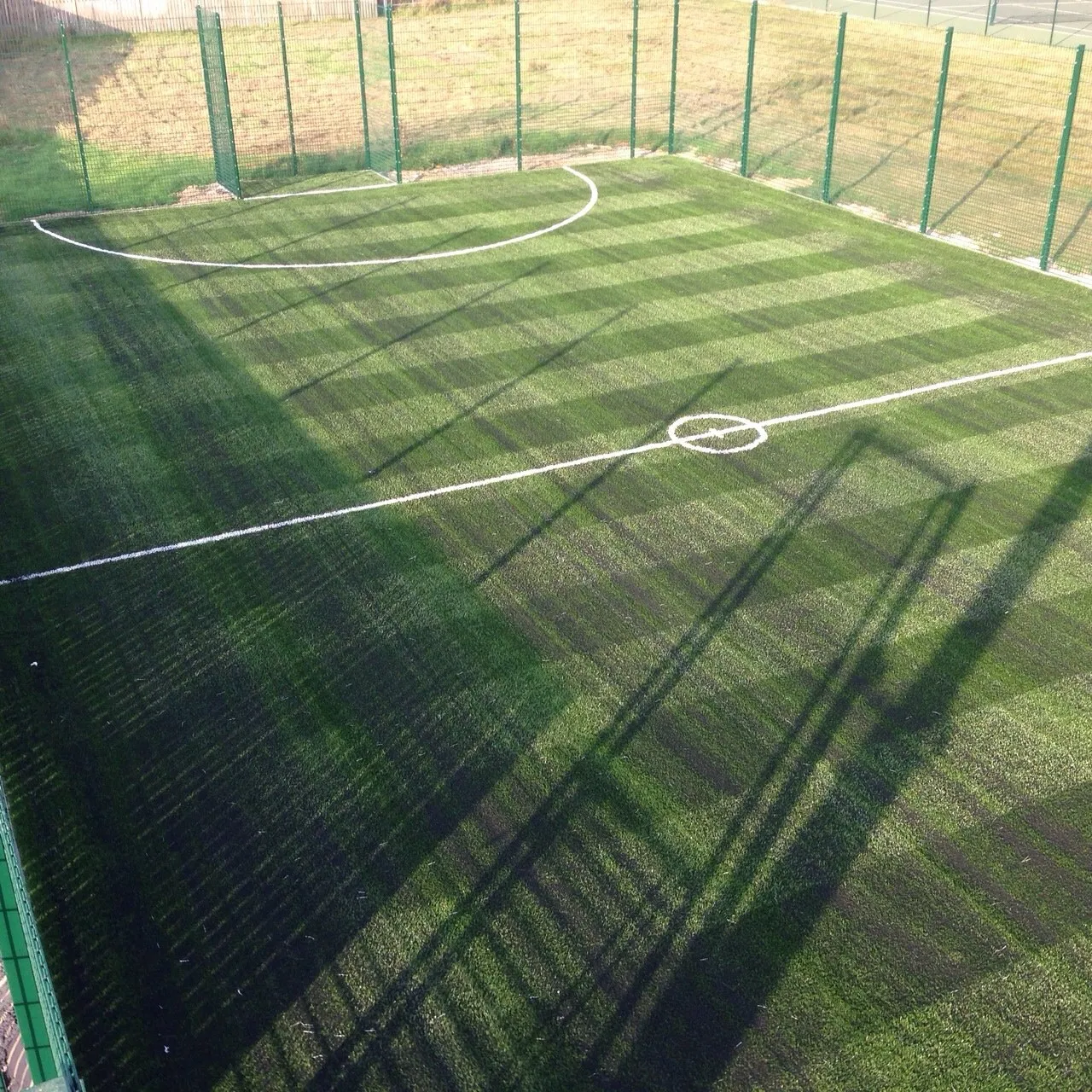
Sand-filled pitch re-turfed as a 3G football pitch in Warrington
Football3G synthetic turf
A 3G pitch is long-pile artificial grass filled with sand and rubber or an alternative infill, with 55 to 60 mm the preferred football pile in Sport England’s 2013 guidance.
4.6 from 22 Google reviews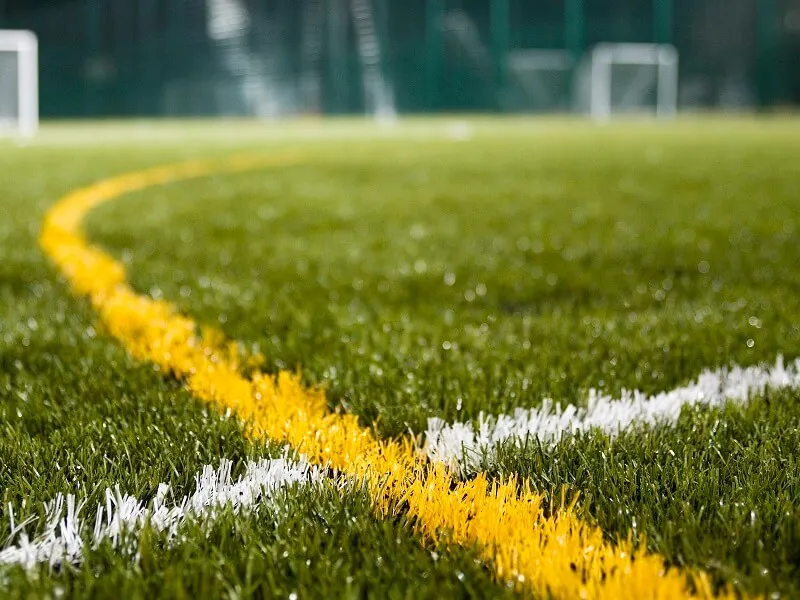
At Sports and Safety Surfaces, we design, build and look after 3G pitches for schools, colleges, universities, leisure centres and clubs, from the stone base and shock pad to the carpet, the sand and rubber infill and the inlaid lines.
Call us on 01625 445766 to talk through your pitch, or ask us for a free quote.
3G pitches are third-generation artificial grass surfaces whose long synthetic pile is filled first with silica sand and then with rubber crumb or another infill, and Sport England names 55 to 60 mm as the preferred pile for football (Sport England, Artificial Surfaces for Outdoor Sport, 2013).
The sand sits at the bottom of the pile, where it weighs the carpet down and holds the fibres upright. The rubber on top gives the ball its bounce and gives players the give underfoot they expect from grass.
Carpets filled with sand alone are often called 2G. Adding rubber to a longer pile is what turns a pitch into 3G, which clubs also call a 3G astro or simply the artificial pitch.
3G pile heights and what each is used for (Sport England, 2013; Football Foundation, 2026; World Rugby Rugby Turf Performance Specification, 2020).
| 3G type | Pile height | Used for |
|---|---|---|
| Short pile | 40 mm | Football; FIFA Quality community systems are typically 40 to 50 mm |
| Long pile | 55 to 60 mm | Sport England’s preferred 3G football surface |
| Long pile over a shock pad | 60 to 65 mm | Sport England’s rugby surface; World Rugby recommends a 60 mm carpet and sets 50 mm as the minimum |
Every 3G pitch the Football Foundation has funded since January 2023 has a shock pad under the carpet (Football Foundation, 2026). Non-fill systems, which the Football Foundation calls 4G, are on the market too, and our guide to 3G, 4G, 5G and 6G pitches explains what each label means.
We install 3G carpets with piles from about 32 mm up to 65 mm, in monofilament or fibrillated fibres of polyethylene or polypropylene, chosen for the sport, and we buy them from makers including Playrite, Lano Sports and Rhino Turf.
For football our standard specification is a 40 mm 3G carpet over a preformed or in situ shock pad, with the pad chosen to suit the sub-base. Longer piles of 60 mm or more go where rugby is played.
A monofilament fibre is a single blade, harder wearing and longer lasting. A fibrillated fibre splits into a fine net that holds the sand and rubber with less movement, and it usually costs less.
Polyethylene fibres are waxy and densely packed into the backing. The quality of any carpet comes down to its pile weight, its yarn density and its stitch rate.
We are not tied to one turf maker. We listen to what the pitch has to do, give you our view on the carpet, and leave the final choice to you.
Some of the 3G carpets we specify, as their makers describe them (our own product notes).
| Carpet | Maker | What it is made for | Notes |
|---|---|---|---|
| RT50 | Rhino Turf | 5-a-side football areas | Two monofilament yarns; laid with or without a shock pad, as the test results require |
| RT60 | Rhino Turf | Full-size football pitches | Two monofilament yarns; laid with or without a shock pad, as the test results require |
| RT65 | Rhino Turf | Full-size and training rugby pitches | Two monofilament yarns; an in situ rubber shock pad where the tests call for one |
| Profoot MXSi | Lano Sports | Football | Sand and rubber filled; 40, 50 or 60 mm pile; 1,700 g/m² pile weight at 60 mm; diamond-shaped yarn |
| Interplay | Lano Sports | Football and hockey on one pitch | Crimped monotape yarn in two tones of green |
| 60 mm carpet | Playrite | Football | Filled with silica sand and rubber crumb |
Other makers on the UK market include TigerTurf, Mondo, Polytan and Desso. For competitive hockey, England Hockey’s view on 3G applies whatever the carpet, as the sports section below explains.
3G synthetic turf costs £1,215,000 to £1,275,000 for a full-size 106 by 70 metre football pitch with fencing and floodlights, rising with the pile from 40 mm to 65 mm (Sport England 3Q2026 benchmark, excl. VAT).
Sport England’s 3G figures leave out site conditions, so our own price follows a survey; each pile height’s benchmark and what it includes is on our cost page.
Going from a 40 mm to a 65 mm carpet adds £60,000, about 5% of the total. A natural turf senior pitch is benchmarked at £120,000, with a year of maintenance and grow-in included, so 3G costs far more to build (Sport England 3Q2026 benchmark, excl. VAT).
On a real job the price moves with the size of the pitch, the carpet and its colour, access for machinery, and extras such as rebound fencing from 3 to 5 metres high and floodlights. Tell us your budget at the start and we will design the specification around it: call 01625 445766.
To see 3G priced beside the other all-weather surfaces, read what an all-weather pitch costs.
3G synthetic turf suits football at every level on The FA 3G Pitch Register, rugby on a field that meets World Rugby Regulation 22, and only introductory hockey where no other surface is available, in England Hockey’s view (Football Foundation, 2026; England Hockey facilities FAQs, read November 2026).
Where each governing body stands on 3G synthetic turf (Football Foundation, 2026; World Rugby Rugby Turf Performance Specification, 2020; England Hockey facilities FAQs, read November 2026).
| Sport | Position on 3G | What it takes |
|---|---|---|
| Football | Played on 3G at every register level: FIFA Quality Pro, FIFA Quality, FA 11v11, FA Small Sided and FA Recreational | A listing on The FA 3G Pitch Register and a performance retest every 3 years; an expired pitch cannot host FA-affiliated football |
| Rugby union | Played on 3G that meets World Rugby Regulation 22 | Head impact results of at least 1.3 m in the laboratory and at least 1.45 m on the field, and a retest at most every two years |
| Hockey | Not suitable for competitive hockey, in England Hockey’s view | Introductory hockey only, where no other surface is available |
A 40 mm pile is the common choice for football and also suits futsal. Rugby league and rugby union need a longer, more cushioned pile, and World Rugby strongly recommends a 60 mm carpet (World Rugby Rugby Turf Performance Specification, 2020).
On a 3G field that meets Regulation 22, the RFU allows full-contact matches, with tackling, rucking and mauling, scrums and lineouts (RFU, artificial grass pitches). Sport England’s 2013 guidance adds that competitive, full-contact rugby union and league need pitches with a high degree of shock absorbency, to their governing bodies’ specifications (Sport England, 2013).
A 3G pitch can be built for 11-a-side or for 5, 7 and 9-a-side football. A full-size pitch is often divided across its width into 3 or 4 small-sided pitches, each with its own inlaid lines.
The FA’s 3G guide recommends white for the main pitch lines, tufted in when the carpet is made, then yellow for 7v7, blue for 9v9 and red for 5v5 and training (The FA 3G pitch design guide, 2020). Our guide to football pitch sizes and markings sets out each format’s lines.
England Hockey sets out the difference plainly: a 3G pitch “is not as dense as a sand filled or a sand-dressed pitch”, and “the pile is also considerably longer” (England Hockey facilities FAQs, read November 2026). We recommend 3G for recreational hockey only.
Schools use 3G so that weather no longer cancels PE, while colleges, universities, leisure centres and clubs hire their pitches out in the evenings and at weekends. For the build sport by sport, see 3G football pitch construction, 3G rugby pitch construction to Regulation 22 and Multi-Use Games Area (MUGA) construction.
3G synthetic turf has a 40 to 65 mm infilled pile against 23 mm for sand-filled and 18 mm for sand-dressed turf, and a senior sand-filled football pitch costs £90,000 less than a 40 mm 3G one (Sport England 3Q2026 benchmark, excl. VAT).
3G, sand-filled and sand-dressed turf compared (Sport England 3Q2026 benchmark, excl. VAT; Sport England, 2013).
| Feature | 3G | Sand-filled | Sand-dressed |
|---|---|---|---|
| Pile height | 40 to 65 mm | 23 mm (23 to 25 mm in the 2013 guidance) | 18 mm |
| Between the fibres | Sand, then rubber crumb or an alternative | Sand | A sand dressing |
| Main sports | Football; rugby to Regulation 22 | Hockey and football | Hockey, mainly on multi-use areas |
| Senior football pitch, 106 × 70 m | £1,215,000 to £1,275,000 | £1,125,000 | No benchmark |
| Hockey pitch, 101.4 × 63 m | No benchmark | £970,000 | £1,035,000 |
A sand-filled carpet has an upright tufted pile packed with sand. A sand-dressed carpet is shorter and denser, with less sand, and suits pitches where hockey comes first.
Against natural grass, a 3G pitch needs no mowing, no pesticides and no watering, and its porous layers let rain drain away so play can carry on through wet weather. Every system is set side by side in all sports surface types compared.
A 3G football pitch is tested to earn its status on The FA 3G Pitch Register, from FA Recreational up to FIFA Quality Pro, and a UKAS-accredited testing consultant retests it every 3 years to keep that listing (Football Foundation, 2026).
FIFA’s two marks come from its own laboratory and field tests (FIFA Quality Programme). The tests measure how the finished pitch plays, including ball roll, ball rebound and vertical deformation, and the carpet’s grade, pile weight and yarn density all affect the results.
A shock pad is tested in its own right for water permeability, vertical deformation, shock absorption, energy restitution and dimensional stability. Shock pads are specified to BS EN 15330-4:2022, and the turf itself to BS EN 15330-1:2013.
A rugby pitch to World Rugby Regulation 22 must reach a head impact result of at least 1.45 m on the field and is retested at most every two years (World Rugby Rugby Turf Performance Specification, 2020). FIFA’s marks belong to a tested pitch, so ask for the register entry of the pitch itself.
A pitch shown as Expired on the register cannot host FA-affiliated football (Football Foundation, 2026). How each sport’s tests run is explained on our page about sports surface standards and testing.
3G pitches are not banned: the EU restriction on intentionally added microplastics stops rubber crumb being bought within the EU from October 2031, and it stops neither the use of existing rubber-crumb pitches nor new ones built before then (Sport England 3G position statement, June 2025).
The EU adopted the restriction in September 2023 with an eight-year transition. In the UK the rules are set at UK level, with Northern Ireland following the EU’s REACH regulation.
The joint position statement from Sport England, the Football Foundation, The FA, SAPCA, England Rugby, the RFL and others gives no date for any UK ban (Sport England 3G position statement, June 2025). It points to a DEFRA report of May 2025 that found 3G pitches the highest source of intentionally added microplastics.
The statement recommends perimeter boards, drainage filters, boot brushes and exit grids to keep the infill where it belongs. BS CEN/TR 17519:2020 gives guidance on stopping infill spreading into the surroundings.
For a new pitch, the infill is now a decision to make early: rubber crumb, a vegetal or mineral infill, or a non-fill system (Football Foundation, 2026).
We build 3G synthetic turf on either an engineered base of compacted stone under porous macadam or a dynamic base of deeper compacted stone, then lay the shock pad, roll out and join the carpet, and brush in silica sand followed by rubber crumb.
The work starts by excavating the existing ground and installing drainage under a porous stone sub-base. An engineered base finishes with macadam laid to tight tolerances, while a dynamic base takes a preformed shock pad straight onto the stone.
A 3G pitch build-up, from the ground up (Sport England, 2013; Football Foundation, 2026; BS EN 15330-4:2022).
| Layer | What goes in |
|---|---|
| Formation | The ground excavated and shaped, with drainage and a geotextile layer |
| Stone sub-base | Typically 300 mm |
| Porous macadam | Typically 65 mm |
| Shock pad | Specified to BS EN 15330-4:2022; in every Football Foundation funded 3G pitch since January 2023 |
| Carpet | 40 to 65 mm pile, chosen for the sport |
| Infill | Sand first, then rubber crumb or a vegetal or mineral alternative |
| Line markings | Inlaid in the colour for each sport the pitch will host |
An in situ rubber shock pad is 2 to 6 mm SBR crumb mixed with a binder and laid by machine or by hand, about 15 mm deep on macadam or 25 mm on stone. It stops the carpet backing rucking, and it can even out small contours in the base, though getting the sub-base right is the cheaper fix.
Prefabricated pads, such as Rebounce polyurethane foam and the Brock and Matchpad systems, are the other route. Any good pad cushions players’ joints, protects the carpet and should last at least two carpet cycles (Football Foundation, 2026).
Keeping the infill on the pitch is part of the build. The Football Foundation recommends 500 mm boards around the edge, grates or mats at the entrances, brush-off zones and silt traps in the drainage (Football Foundation, 2026).
Our advice is free, so call 01625 445766 before the specification is fixed.
3G synthetic turf lasts about ten years as a rule of thumb, or 12 or 13 years when it is well maintained, the Football Foundation says, and the upkeep Sport England lists starts with drag brushing every fortnight and de-compaction twice a year (Football Foundation, 2026; Sport England life cycle costs, 2Q2023).
Routine care for a 3G pitch (Sport England life cycle costs, 2Q2023; Football Foundation, 2026).
| Task | How often |
|---|---|
| Drag brushing | Every fortnight |
| De-compaction | Twice a year |
| Infill top-up and re-dressing | No interval set in the guidance |
| Weed and moss treatment | No interval set in the guidance |
| Inspection and condition report on the carpet, joints, seams, markings and shock pad | Every year |
| Performance retest for The FA 3G Pitch Register | Every 3 years |
Drag brushing spreads the sand and rubber evenly through the fibres. Keep leaves, litter and dirt off the carpet as well, because compacted or contaminated infill slows the drainage and lets moss and algae take hold.
Topping up the rubber keeps the ball bouncing true and the water draining. Where the infill runs thin, the fibres lie flat and the surface turns slippery.
Even a well-kept pitch can flood after a cold snap. Heavy rain straight after a very cold spell, or snow or frost thawing, can leave water on a synthetic turf pitch for a few hours while the infill underneath is still frozen, SAPCA’s code says (SAPCA code of practice, synthetic turf pitches, 2009).
Check the pitch yourself often, so a lifted seam or a worn patch is put right before it spreads. Small seam repairs can be made with an artificial grass repair kit, and we can test the surface to set a maintenance schedule.
Near the end of a carpet’s life, a full rejuvenation cleans the infill and takes out the contamination, which buys a few more years. When the carpet does need replacing, a Turf Muncher machine lifts it, separates out the infill and rolls the turf up for reuse or recycling.
When you compare carpets, the Football Foundation suggests looking for an 8-year warranty against abnormal wear or tuft loss (Football Foundation, 2026). Artificial pitch maintenance and rejuvenation covers the work in detail, frost and snow included.
3G pitches have rubber crumb as their performance infill, made from recycled end-of-life tyres and spread into the long pile over the sand, though vegetal and mineral infills and non-fill systems are on the market as well (Football Foundation, 2026).
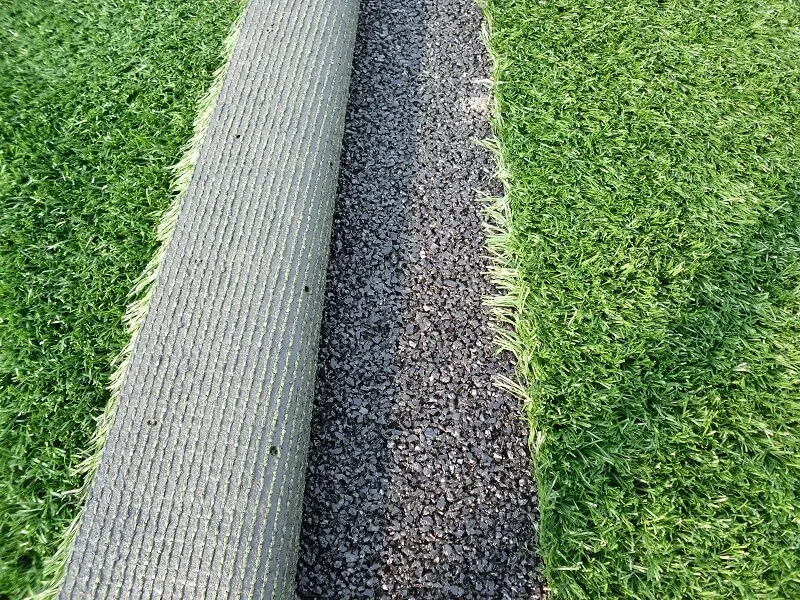
The rubber gives a 3G pitch its natural playing feel and cushions players’ joints. We spread SBR or EPDM granules over a bed of silica sand.
Both infills have to meet the specification for the pitch’s playing characteristics, so we never save money by using cheaper materials. Choosing an infill has its own industry guidance, SAPCA’s code of practice on performance infills for 3G turf (1st edition, February 2021).
The choice now has a date attached too, because rubber crumb can no longer be bought within the EU from October 2031 (Sport England 3G position statement, June 2025).
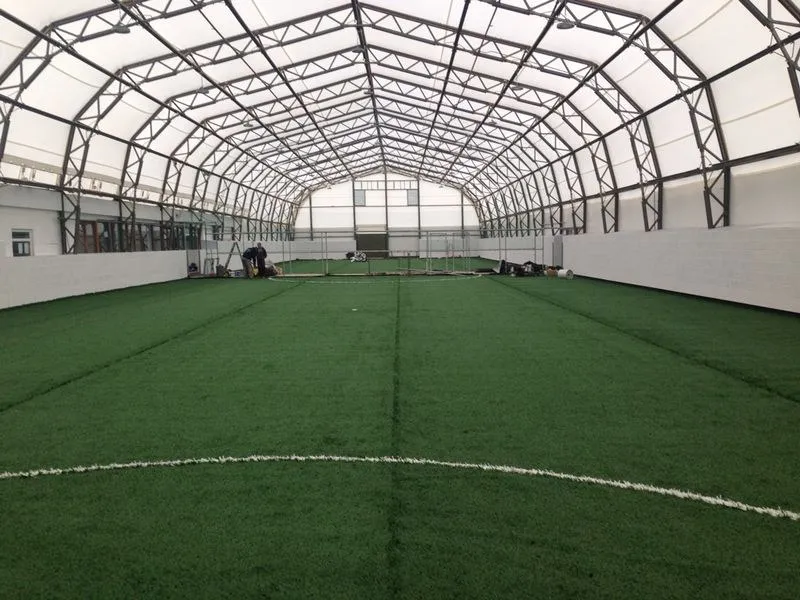
We have installed 3G synthetic turf on a sand-filled football pitch re-turfed in 3G, a worn court resurfaced as a covered 3G 5-a-side pitch, and a new 3G 5-a-side pitch built on grass.
The covered court kept its existing macadam base, and the new pitch went down on porous stone and macadam. The hero photograph and the rubber crumb close-up on this page come from our own jobs too.
To plan a 3G pitch for your own site, call 01625 445766. We start by measuring up on site, checking access and going through the budget and funding, and only then write the specification.
Players on a 3G pitch should wear boots with moulded plastic studs or soles made for artificial grass. Metal studs and blades damage the carpet, soft-ground boots are out, and firm-ground boots with moulded studs are usually fine.
Turf makers usually work to a lead time of 4 to 6 weeks for a 3G carpet. We plan the time on site and the quote around that delivery, so the carpet arrives as the base and shock pad are ready.
A 3G carpet can melt where sunlight bounces off windows, glazed doors or shiny panels and concentrates heat on the polyethylene fibres. Fire, bonfire ash and barbecue embers can melt it too, so screen any reflective surface beside the pitch.
A 3G pitch needs no watering in dry weather, where natural grass can bake almost as hard as tarmac. After heavy rain its porous base stores the water beneath the surface, so a downpour rarely stops play.
We price every 3G pitch from a survey of your site: we measure up, check access, dimensions and budgets, and then write a specification around the sports you play.
Call 01625 445766 or send us your site details for a free quote.
Football3G synthetic turf
Football3G synthetic turf
Football3G synthetic turf
© OpenStreetMap contributors
Need more information?