
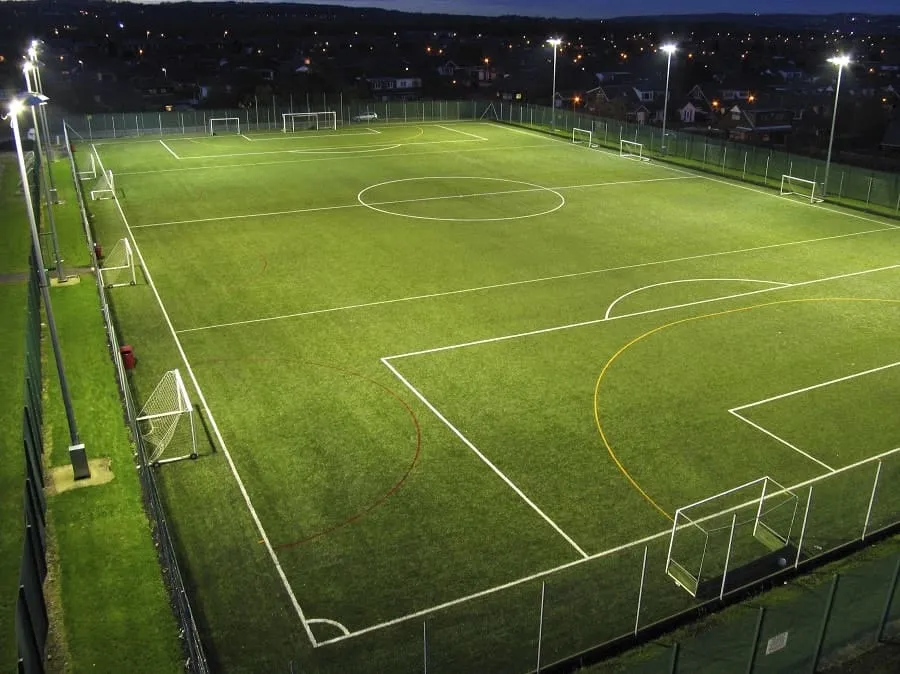
3G pitch
55 to 60 mmLong pile filled with sand and then rubber crumb or another infill, at Sport England’s preferred height for football (2013).
Sports surfaces differ by pile height and infill, from 12 to 14 mm water-based hockey turf to 60 to 65 mm 3G for rugby, and governing bodies such as England Hockey and World Rugby set which suit competitive play.
4.6 from 22 Google reviews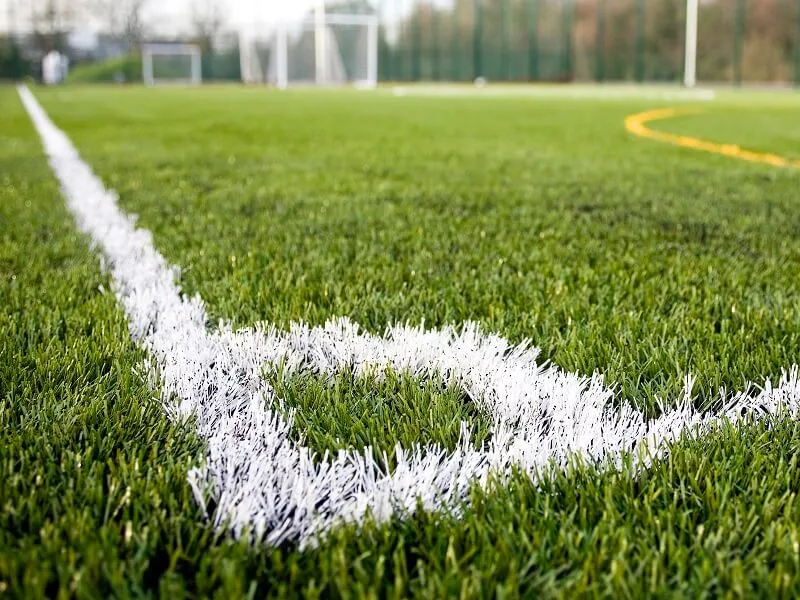
55 to 60 mmLong pile filled with sand and then rubber crumb or another infill, at Sport England’s preferred height for football (2013).
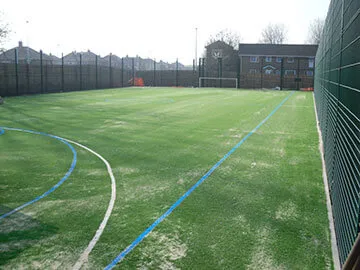
23 mmSport England prices this sand-filled carpet for hockey at £970,000 and for senior football at £1,125,000, fenced and floodlit (3Q2026, excl. VAT).
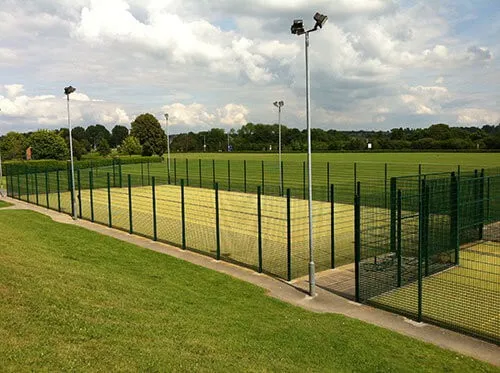
18 mmWhere hockey comes first on a multi-use area, Sport England’s guidance points to this shorter, denser pile (2013).
12 to 14 mm
The shortest hockey carpet in Sport England’s guidance (2013); England Hockey will urge owners to consider a no-water alternative when one is resurfaced.
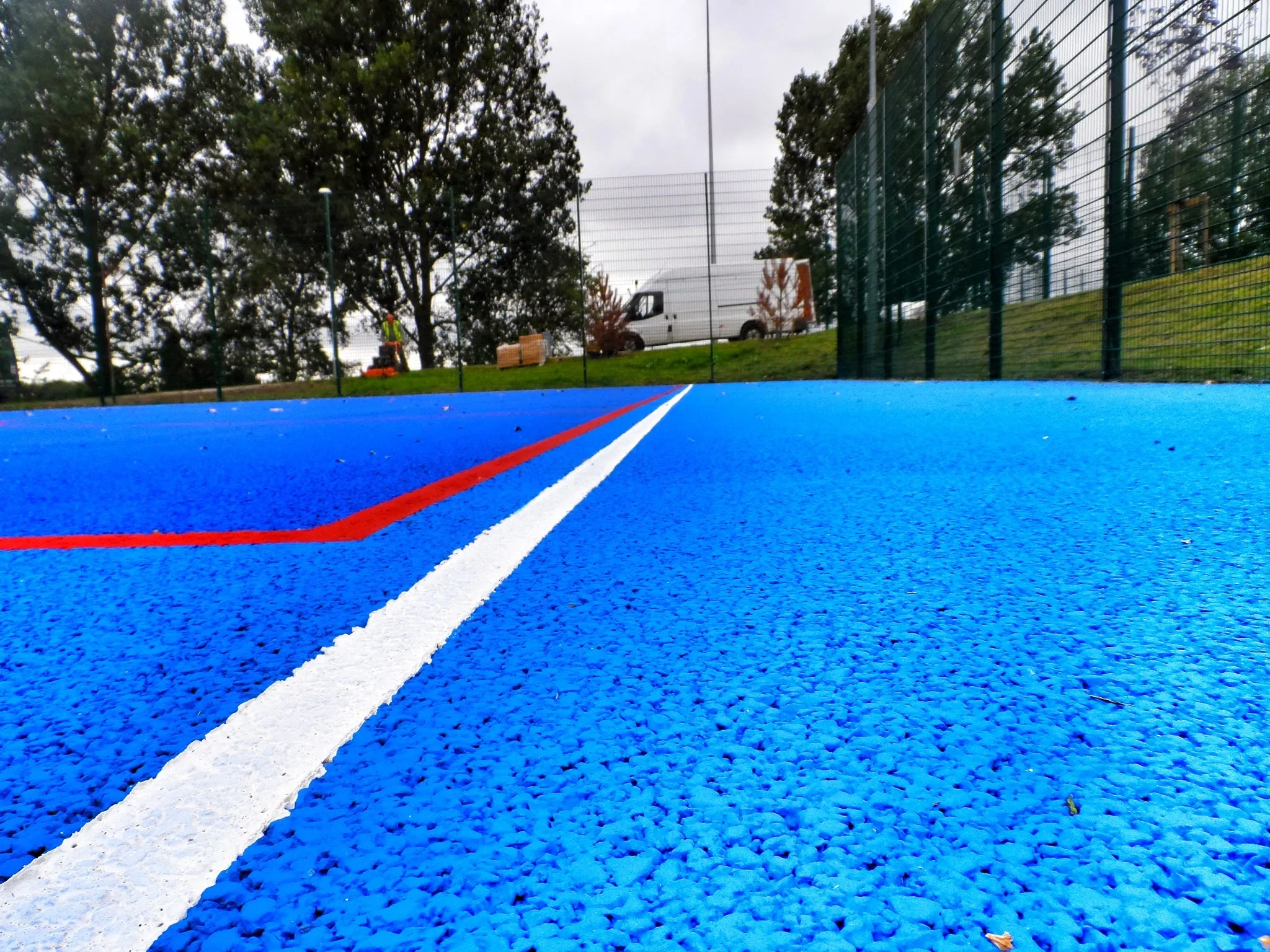
BS EN 14877:2013Polymeric courts are covered by this standard, and Sport England’s earlier MUGA classification put polymeric over macadam in Types 3 and 4 (2013).
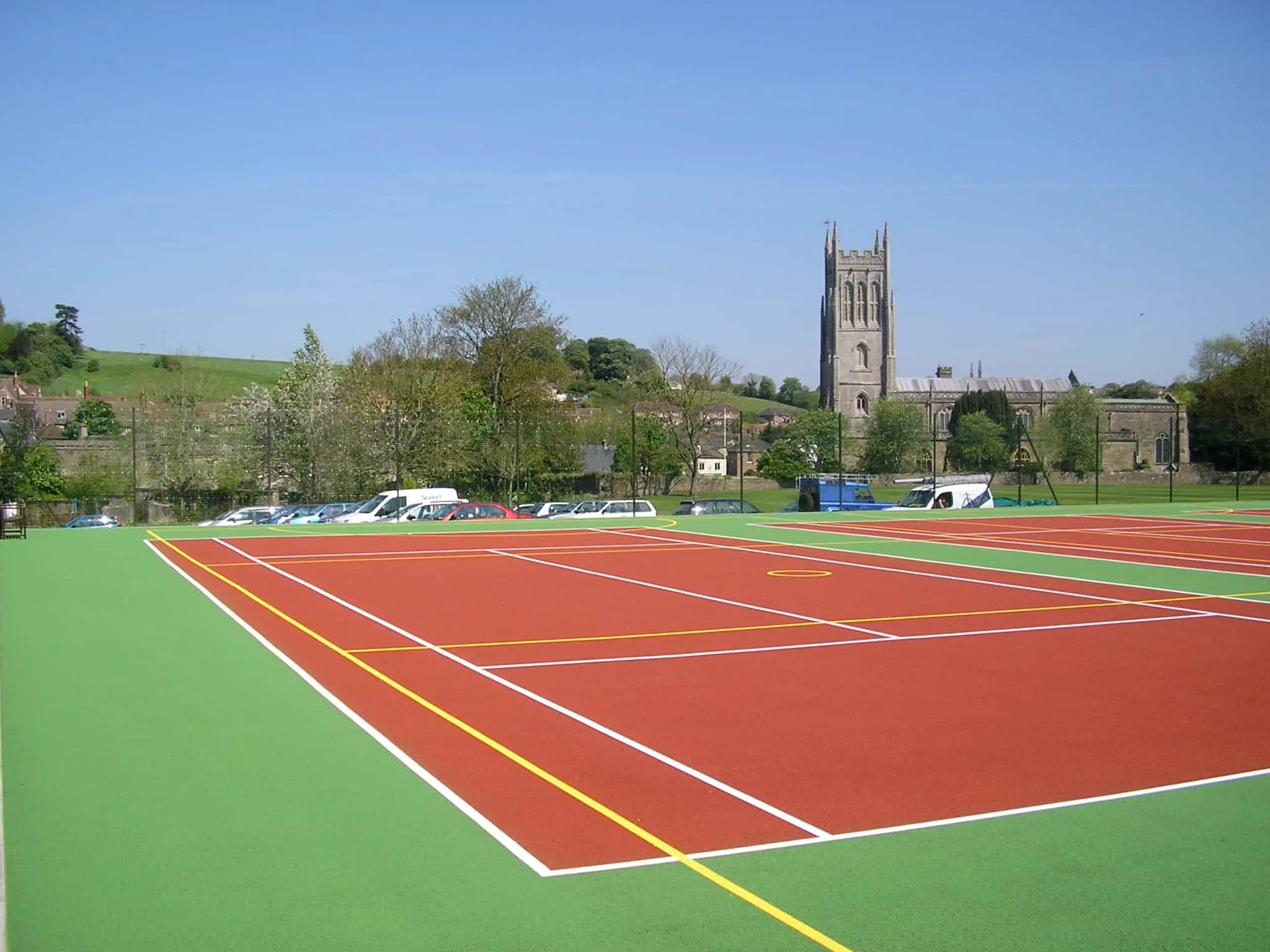
£195,000Of the MUGA surfaces, only macadam has a line in Sport England’s cost guide: a fenced, floodlit 36.6 by 21.35 metre court (3Q2026, excl. VAT).
At Sports and Safety Surfaces, we design and build outdoor sports surfaces for pitches, courts and Multi-Use Games Areas (MUGAs), for football, rugby, hockey, tennis, netball and basketball at schools, colleges, clubs and leisure centres.
Each surface can be designed around a different area size and budget, and for recreational or competitive play. Call us on 01625 445766 for a free quote.
We install all types of sports surfacing including 3G grass pitches, artificial all weather pitches, athletics surfacing and tennis courts, and those facilities are built in the surface systems compared below, from 3G and sand-based turf to polymeric and porous macadam.
Each system has its own page on what it is, which sports suit it, how it is built and what it costs:
Coloured line markings let one surface carry several sports, and floodlighting and rebound fencing can be added to any of them.
If the name Redgra has come up while you compare surfaces, our Redgra sports surface guide covers it. Every sport we build for is on our sports surfacing home page.
Football pitch surfaces differ by pile and infill: Sport England’s 2013 guidance names 55 to 60 mm long-pile 3G as the preferred 3G football surface, with short-pile 3G at 40 mm and sand-filled turf at 23 to 25 mm (Sport England, Artificial Surfaces for Outdoor Sport, 2013).
Sports surface systems compared by pile height, fill and main sports; the benchmark costs follow in the cost table below (Sport England, 2013).
| Surface | Pile height | Between the fibres | Main sports |
|---|---|---|---|
| 3G, long pile | 55 to 60 mm for football; 60 to 65 mm over a shock pad for rugby | Sand, then rubber crumb or an alternative | Football and rugby |
| 3G, short pile | 40 mm | Sand, then rubber crumb or an alternative | Football |
| Sand-filled | 23 to 25 mm (23 mm priced) | Sand | Hockey and football |
| Sand-dressed | 18 mm | A sand dressing | Hockey, mainly on MUGAs |
| Water-based | Typically 12 to 14 mm | Watered | Hockey |
| Polymeric | No pile | None | Netball, basketball and general play |
| Porous macadam | No pile | None | Tennis, netball and MUGAs |
The pitches behind those figures are 106 by 70 metres for senior football and 101.4 by 63 metres for hockey (Sport England, 3Q2026).
The pile column is where the systems split. The longest carpets are for football and rugby, and the shortest, densest ones for hockey.
A 3G carpet’s yarn can be fibrillated or monofilament, and the rubber crumb in the pile holds the fibres upright.
A needle punch sports surface is a fibre bonded synthetic turf, also called multisport turf, with curly yarn that locks a silica sand infill in place, and BS EN 15330-1:2013 covers needle-punched surfaces alongside synthetic turf (BSI Knowledge, read November 2026).
Its short pile suits football, tennis, hockey, basketball and netball. It also makes a recreational surface for athletics tracks and long jump runways where a competition-grade polymeric surface is not needed.
Primary schools often choose it because it gives a softer, more impact-absorbing landing than macadam or polymeric rubber. It comes in red, blue, green and yellow, which allows rainbow designs for younger children.
Many schools and clubs lay it to replace a muddy grass area, since it is more durable and easier to look after than natural grass.
Sport England’s cost guide has no needle punch line, so it carries no benchmark figure here.
Needle punch goes down on an engineered macadam sub-base where possible, because that gives the most even levels, or on a dynamic stone sub-base. A long jump runway can be laid straight onto dynamic stone.
On a multi-use games area a shock pad may go in first, to absorb impact and cushion joints, and it can be laid over an existing tarmac area.
The carpet is laid in sections and glued at the joints and edges, then silica sand is brushed through the fibres. Inlaid line markings are made by cutting out each line and setting in turf of a contrasting colour.
We expect a needle punch surface to give around 10 years of play, and regular maintenance can add around 4 to 5 years to that.
Routine brushing keeps the sand evenly spread and lifts out dirt. Deep cleaning, repairs after heavy use or vandalism, and a sand rejuvenation if the infill is contaminated follow as needed.
Twigs and leaves on a track or runway are a trip and slip risk, so they are cleared regularly. Contaminated sand loses its porosity and leaves water pooling on the surface.
Rebound fencing from 3 m to 5 m high, floodlights, goal ends, long jump sand pit covers and maintenance equipment can all be added. The size follows the use: a primary school runway can be shorter than one at a club or secondary school, and more runway lanes need a bigger sand pit.
Grants from funding bodies can help schools and clubs pay for needle punch games areas, tracks and runways, and funding for sports facilities sets out the main programmes. Call us on 01625 445766 to talk through a needle punch surface for your school or club.
3G costs £1,215,000 to £1,275,000 for a full-size football pitch, sand-filled to water-based turf £970,000 to £1,155,000 for a hockey pitch, and macadam £195,000 for a Multi-Use Games Area (MUGA), all fenced and floodlit (Sport England 3Q2026 benchmark, excl. VAT).
Sport England 3Q2026 benchmark costs by surface, fenced and floodlit, excl. VAT (Sport England Facility Costs, 3Q2026).
| Facility | Size | Surface | Benchmark cost |
|---|---|---|---|
| Senior football pitch | 106 × 70 m | 3G, 40 to 65 mm | £1,215,000 to £1,275,000 |
| Senior football pitch | 106 × 70 m | Sand-filled, 23 mm | £1,125,000 |
| Sport England’s U9/U10 and training pitch | 61 × 43 m | 3G, 40 to 65 mm | £530,000 to £555,000 |
| Sport England’s U9/U10 and training pitch | 61 × 43 m | Sand-filled, 23 mm | £480,000 |
| Senior rugby union pitch | 130 × 80 m | 3G, 65 mm | £1,685,000 |
| Senior rugby league pitch | 122 × 74 m | 3G, 65 mm | £1,570,000 |
| Hockey pitch | 101.4 × 63 m | Sand-filled, 23 mm | £970,000 |
| Hockey pitch | 101.4 × 63 m | Sand-dressed, 18 mm | £1,035,000 |
| Hockey pitch | 101.4 × 63 m | Water-based | £1,155,000 |
| MUGA | 36.60 × 21.35 m | Porous macadam | £195,000 |
| Tennis, 2 courts | 36.58 × 33.53 m | Porous macadam | £270,000 |
| Tennis, 4 courts | 36.58 × 64.01 m | Porous macadam | £475,000 |
| Tennis, 6 courts | 36.58 × 94.49 m | Porous macadam | £620,000 |
Each figure in the table is a Sport England benchmark before VAT, and the price for your own pitch or court follows our survey of the site. For what Sport England’s benchmarks include and leave out, see our 3G pitch cost guide.
Polymeric is missing for a reason. The guide prices its MUGA in macadam only, with no line for a polymeric or a 3G MUGA (Sport England, 3Q2026).
On a real project the price moves with the design, the size of the area, the location and the extras, such as floodlighting and rebound fencing. Tell us your budget and we will shape the specification around it in a free quote.
Each sports surface suits different sports: 3G suits football and, at Regulation 22 standard, rugby; England Hockey does not consider 3G suitable for competitive hockey; and England Netball lists macadam, sand-dressed turf, polymeric and acrylic for outdoor netball (World Rugby Regulation 22; England Hockey facilities FAQs, read November 2026; England Netball Knowledge Centre, 2025).
Which surface suits which sport, by governing body and guidance (World Rugby, 2020; England Hockey; England Netball, 2025; Sport England, 2013).
| Sport | Surfaces | What the governing body or guidance says |
|---|---|---|
| Football | 3G; sand-filled | 55 to 60 mm long-pile 3G is Sport England’s preferred 3G football surface, and Sport England also prices a senior sand-filled pitch |
| Rugby union | 3G over a shock pad | The field must meet World Rugby Regulation 22, with head impact results of at least 1.3 m in the laboratory and 1.45 m on the field, and a retest at most every two years |
| Hockey | Water-based, sand-dressed, sand-filled | England Hockey does not consider 3G suitable for competitive hockey; 3G will do for introductory hockey only where no other surface is available |
| Netball | Macadam, sand-dressed turf, polymeric, acrylic | England Netball lists all four outdoors, and says acrylic’s lack of porosity reduces its value in the UK |
| Tennis and multi-sport | Porous macadam; polymeric | Sport England’s earlier MUGA classification gave porous macadam to tennis-first courts (Type 1) and polymeric over macadam to recreational football, basketball and general play (Type 4), which it did not recommend for tennis or netball because of its greater shock absorbency and lower surface friction |
For certified hockey fields, FIH ties the turf to the level of play (FIH Hockey Turf and Field Standards, Part 2). Its Category 1 and 2 fields use watered, non-filled turf, covered in our water-based hockey turf guide, and Category 3 fields, for national and local competitions, may use sand-dressed turf as well.
You may still hear porous macadam courts called Type 1 or Type 2 MUGAs, polymeric courts Type 3 or Type 4, and artificial grass with a shock pad Type 5 (Sport England, 2013).
The earlier classification is history, and Sport England now groups artificial grass by pile height and fill (Sport England, 2013). It still shows the logic of matching the surface to the sport played most.
Synthetic turf sports surfaces are specified to BS EN 15330-1:2013 and polymeric ones to BS EN 14877:2013, with governing-body programmes on top, such as FIFA’s Quality Programme for football, World Rugby Regulation 22 and the FIH Quality Programme for hockey (BSI Knowledge, FIFA, World Rugby and FIH, all read November 2026).
Standards and test programmes for sports surfaces (BSI Knowledge, FIFA, World Rugby and FIH, all read November 2026).
| Standard or programme | Edition | What it covers |
|---|---|---|
| BS EN 15330-1:2013 | Published 30 September 2013, current | Outdoor synthetic turf and needle-punched surfaces for football, hockey, rugby union training, tennis and multi-sports: performance, durability, product identification and facility tests |
| BS EN 14877:2013 | Published 30 September 2013, current and under review | Synthetic (polymeric) surfaces, laid in situ or prefabricated, for outdoor athletics, tennis and multi-sports |
| FIFA Quality Programme for Football Turf | Test Manuals I and II, 2024 Edition, Version April 2026 | Laboratory and field tests; a pitch that passes gets the FIFA QUALITY or FIFA QUALITY PRO mark |
| World Rugby Regulation 22 | Rugby Turf Performance Specification in effect from 1 June 2020 | Laboratory tests by an Accredited Test Institute and field tests on the finished pitch, repeated at most every two years |
| FIH Quality Programme | Hockey Turf and Field Standards, Part 1 Version 2.1 and Part 2 Version 2.2 | Approval of hockey turf products and certification of hockey fields in five categories |
Each mark or certificate belongs to a tested pitch or a tested product. So when you compare quotes, ask for the test report of the pitch itself.
Sports surface standards and testing explains how each sport’s tests work and how often they come round.
We maintain sports surfaces with drag brushing, pressure washing, infill top-ups and chemical treatments against moss and algae, and Sport England’s life-cycle guidance adds de-compaction twice a year and a yearly inspection of the carpet, joints, seams, markings and shock pad (Sport England life cycle costs, 2Q2023).
On courts and MUGAs the work also covers high-pressure washing, algae and dirt removal, anti-slip coatings, game line marking and surface patching.
Brushing keeps a 3G pitch’s infill even. Every surface wears in time, until it needs regeneration or resurfacing.
Planned cleaning cuts the chance of damage and the cost of repairs later. It also costs less than waiting for a problem and paying for reactive work or an early resurface.
A maintenance visit costs more on a bigger surface, which needs more moss and algae treatment. A job that runs over two or three days also carries the crew’s travel and accommodation.
Artificial pitch maintenance and rejuvenation covers the synthetic turf work in more detail. Call us on 01625 445766 to plan maintenance for an existing pitch or court.
Porous macadam covers about 80% of tennis courts in the UK, the LTA says, and typically lasts ten to twelve years (LTA, 2026). The other main all-year tennis surfaces are artificial grass and artificial clay.
Yes. Painted or inlaid line markings in several colours let one surface carry football, netball, tennis and basketball, which is how a Multi-Use Games Area (MUGA) works, and macadam, polymeric, sand-filled and needle punch surfaces all take multi-sport lines.
Needle punch is the usual choice, and it can go over an existing tarmac playground, with a shock pad first where extra cushioning is wanted. Rebound fencing round the area keeps the balls inside it.
Yes, an artificial surface is more durable and easier to look after than a natural grass pitch. It still needs regular care, and Sport England’s model plans drag brushing every fortnight for an artificial grass pitch (Sport England life cycle costs, 2Q2023).
Call us on 01625 445766 or send us your site details for a free quote on a new pitch, court or Multi-Use Games Area (MUGA).
Tell us the sports you play, the area you have and your budget. We will set out the surface options that fit and the extras worth adding.
© OpenStreetMap contributors
Need more information?