
Athletics running track construction
Running track construction lays one of four synthetic systems, most often porous polyurethane in the UK, over an engineered base, to a 400 metre track with 84.39 metre straights.
4.6 from 22 Google reviews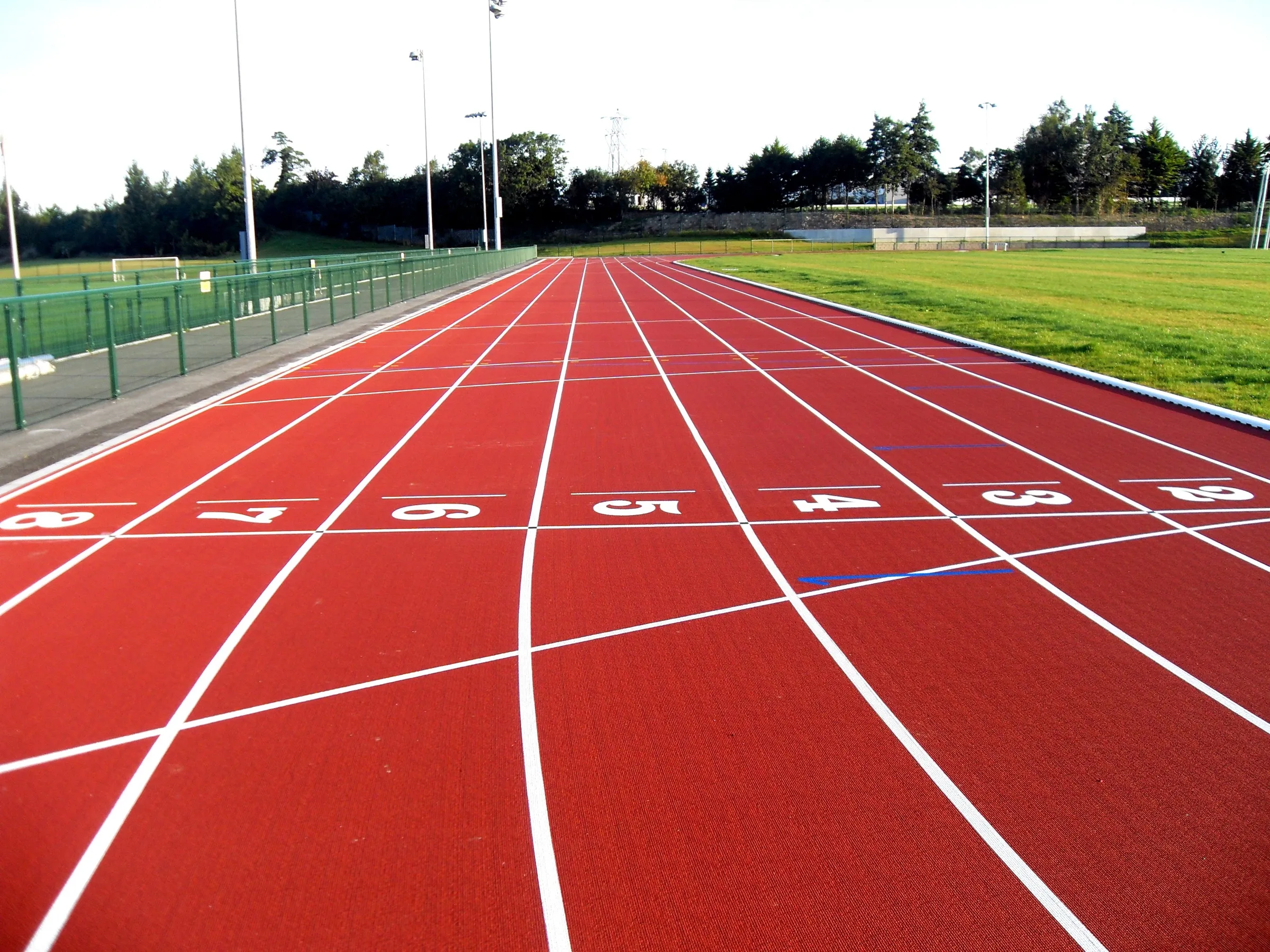
- Lap
- 400 m
- Straights
- 84.39 m each, within 5 mm
- Bend radius
- 36.50 m, within 5 mm
- Surface thickness
- At least 12 mm on average
- Most popular UK system
- Porous polyurethane
- Certification
- Every five years, in SAPCA's code
What is an athletics running track?
An athletics running track is a 400 metre loop of synthetic surfacing, with two 84.39 metre straights joined by two bends of 36.50 metres radius on the standard track, laid in one of the four systems SAPCA’s 2021 code describes (SAPCA, 2021).
Those systems are prefabricated, solid polyurethane, sandwich and porous polyurethane. Each goes down over an engineered base, which SAPCA covers in a separate code of practice for bases under outdoor synthetic sports surfaces (SAPCA, 2024).
At Sports and Safety Surfaces, we build, install and maintain running tracks, from recreational tracks at schools to club tracks built for competition.
The same rubber and polyurethane family is used on courts and multi-use games areas, which our page on polymeric sports surfaces covers.
Which surface is best for a running track?
Porous polyurethane is the most popular running track surface in the UK and suits most club, school and college tracks, SAPCA’s 2021 code says, while solid polyurethane is normally specified for major national and international meetings (SAPCA, 2021).
Where SAPCA’s code of practice, 4th edition, October 2021, places each of the four synthetic track systems.
| System | Where SAPCA’s code places it |
|---|---|
| Porous polyurethane | The most popular UK system, suitable for most club, school and college tracks |
| Sandwich | One of the four generic UK systems |
| Solid polyurethane | Normally specified for major national and international meetings |
| Prefabricated | One of the four generic UK systems |
In the trade, porous polyurethane is usually called structural spray, and solid polyurethane full pour. Structural spray is porous, so rain drains through it and the track stays in use in wet weather, while sandwich and full pour systems are sealed and let no water through.
A sandwich system starts with a black base mat laid by a paving machine and left 24 to 48 hours to cure. The whole area is then flooded with two-part polyurethane, and EPDM crumb scattered onto it sinks into the base as it cures, which gives the system its name.
Full pour is a base flooded with flexible two-part polyurethane elastomer, with rubber crumb cast into it on site. It is hard-wearing and long-lasting, takes spikes well and has an energy-boosting elasticity, though few UK tracks have it because it costs the most of the three.
For a recreational track at a primary school, we also lay needlepunch synthetic turf, which is softer and cheaper than polymeric and less likely to turn slippery in wet weather. We recommend polymeric rubber for any track built for competition.
Whichever system you choose, the finished surface has to average at least 12 millimetres thick (SAPCA, 2021). For the materials in more depth, see what running tracks are made of.
How much does it cost to build an athletics track in the UK?
An athletics track in the UK costs £1,855,000 for six lanes and £2,015,000 for eight on Sport England’s 3Q2026 benchmark, excluding VAT, with 110 metre straights both sides, a grass infield, sports lighting and artificial-surfaced throws, jumps and end fans (Sport England, 2026).
Those are Sport England’s figures for budgeting, and we price each track from a survey of its own site. What moves the price is the surfacing system, the area, the location, the ground conditions and the access to the site.
Sport England 3Q2026 benchmark costs for an athletics track, excl. VAT (Sport England, 2026).
| Track | What the benchmark includes | Benchmark cost |
|---|---|---|
| 6 lanes | Grass infield, sports lighting, 110 m straights on both sides, and throws, jumps and end fans with an artificial surface | £1,855,000 |
| 8 lanes | The same, with eight lanes | £2,015,000 |
The two extra lanes add £160,000 to the benchmark. The figures leave out VAT, inflation after 3Q2026, poor ground conditions, difficult access, biodiversity net gain, land and regional differences (Sport England, 2026).
Of the three polyurethane systems, structural spray costs the least and full pour the most, with the sandwich system priced in between. When you are ready for a figure of your own, send your site details through the contact page for a free quote.
How can a running track be funded?
A running track can draw on grants such as Sport England’s Movement Fund, which offers grants or pledges of £300 to £15,000, and on a sinking fund that Sport England’s lifecycle model sets at 1.7% of the project cost a year (Sport England, 2026; Sport England, 2023).
We help with grant applications as well, preparing the specification and costs a bid needs, and our funding guide lists the programmes we have checked, with each one’s amount and status.
A school track built to competition standard can also be hired out for events.
What standards must a running track meet?
A running track’s synthetic surface falls under BS EN 14877:2013, the British Standard for synthetic surfaces on outdoor athletics, tennis and multi-sports areas, while World Athletics certifies track products and facilities and SAPCA’s 2021 code calls for certification every five years (BSI; World Athletics, 2026; SAPCA, 2021).
Standards and certification for a running track (BSI; World Athletics, 2026; SAPCA, 2021).
| Standard or scheme | Edition or term | What it covers |
|---|---|---|
| BS EN 14877 | 2013 (current, under review) | The synthetic surface of the track, whether laid in situ or prefabricated |
| World Athletics certification | Procedures last modified 5 May 2023 | The certificate of the track’s surfacing product, and of the finished track |
| UK Athletics TrackMark | Lasts three years | Accreditation of the finished track |
| SAPCA code of practice: The Construction and Maintenance of Athletics Tracks | 4th edition, October 2021 | How the track is built and maintained, and its certification every five years |
BS EN 14877’s public Table 1 sets the friction a synthetic athletics surface must give in the laboratory, measured with the EN 13036-4 pendulum: between 80 and 110 when dry, and between 55 and 110 when wet (BSI).
Contractors use polyurethane binders from different manufacturers, such as Polytech, Polytan, Stockmeier and Rosehill, so two tracks laid in the same system can use quite different products. A World Athletics certificate names a surfacing product or a finished facility, so ask for the product’s certificate when you compare tenders.
How the schemes fit together across every sport is set out in our guide to sports surface standards.
How is an athletic track constructed?
An athletic track is constructed by excavating to the required depth, laying a geotextile membrane and a porous stone sub-base, then macadam, and finally the synthetic surface, which SAPCA’s 2021 code requires to average at least 12 millimetres thick (SAPCA, 2021).
Our build runs in this order:
- Excavation. The existing ground is dug out to the depth the design needs.
- Membrane. A geotextile membrane goes down to stop plants and weeds growing up through the track.
- Sub-base. A stone sub-base follows, porous because of the gaps between the stones, so water drains away. It is designed, specified and tested to SAPCA’s code for bases under outdoor synthetic sports surfaces, 3rd edition, September 2024 (SAPCA, 2024).
- Macadam. A polymeric track always needs a layer of macadam beneath it. Needlepunch turf can go straight onto stone over a small area, but a larger area needs macadam as well.
- Surface. For porous polyurethane, a rubber base mat bound with polyurethane goes down first, then a coloured EPDM coat sprayed on in polyurethane (SAPCA, 2021).
- Markings. Lane lines and staggered starts are painted in weather-resistant line paint.
Alongside the track, we supply fencing, take-off boards, sand pit covers and maintenance equipment. Ask us for a site survey to check the ground and the access before the track is designed.
Specification work before a tender is covered on our sports surface consultancy page.
How long does a running track last?
A running track’s working life is planned around a sinking fund: Sport England’s 2Q2023 lifecycle model for athletics sets aside 1.7% of the project cost each year towards replacement and 0.6% a year for maintenance (Sport England, 2023).
Applied to the 3Q2026 benchmark for a six-lane track, that comes to roughly £31,500 a year for the sinking fund and £11,100 for maintenance. Treat those as approximate, because the percentages date from 2023 and the capital cost from 2026.
Structural spray wears faster than the sealed systems, but a fresh spray coat extends its life for far less than a new surface. Maintenance costs much less than repairs or resurfacing, so budget for it from the day the track opens.
SAPCA’s specimen schedule for a polymeric track asks for a sweep at least once a fortnight, a high-pressure wash every year and a deep clean using a high-pressure scrubber at least every second year. Heavily worn areas are re-textured whenever they appear (SAPCA, 2021).
UK Athletics says the inside two lanes take a disproportionate share of the wear, and that spikes used in the wrong places cause more damage than anything else (UK Athletics factsheet). When the surface does wear through, see running track resurfacing and repairs.
What size is a running track?
A standard running track is 400 metres round, and SAPCA’s 2021 athletics code sets its two straights at 84.39 metres and its bends at a radius of 36.50 metres, each to within 5 millimetres (SAPCA, 2021).
That is the geometry of the six-lane standard track in SAPCA’s code, and Sport England’s cost guide prices eight-lane versions as well (Sport England, 2026).
A track for competition keeps to those standard sizes. A recreational track at a school does not have to be full size, and a smaller layout fitted to the space costs less.
Lane counts, tolerances and how to choose a size are in our running track dimensions guide.
World Athletics’ plan of the standard track measures 176.910 by 92.520 metres to the outside of its lanes, and it sets obstacle-free safety zones of at least 1 metre beside the track as well (World Athletics, 2019).
Why choose Sports and Safety Surfaces for a running track?
Sports and Safety Surfaces takes a running track from the first survey and specification through construction to the cleaning and repairs that keep it in use, and builds the jumps, throws and fencing that go with it.
Our guides cover the field events inside a track: the long jump pit and runway, the triple jump runway and pit and the high jump fan. Beyond athletics, we build tennis courts and artificial grass football pitches, all listed from our home page.
Talk your project through with us on 01625 445766. Everything we build for athletics is on the athletics facilities page.
Frequently Asked Questions
Is an athletics track the same as a running track?
Yes. The two names describe the same facility: the 400 metre synthetic loop, with the field event areas often built inside or beside it.
Why are most running tracks red?
Red holds its colour best. It is the most stable colour under ultraviolet light and fades least in sunlight, which is why most UK tracks are red and why we recommend it, with green and blue the next most resistant to fading.
What should you check before choosing a track contractor?
Run the usual credit checks first, so you know the firm can see the work through. Then ask for the World Athletics certificate of the surfacing product in each tender, because binders and products differ from one manufacturer to the next.
Get a Free Quote for a Running Track
At Sports and Safety Surfaces, we start every track project with a site survey to measure up, check the ground and the access, and talk through the events, the lanes and the budget.
Call us on 01625 445766 or request a free quote through the contact page.
Testimonials
A selection of our Google reviews, posted over several years and quoted word for word. Google shows each review's date. Rating as shown on Google on 16 November 2026.
We had our 2 of our tennis courts rejuvenated by Sports and safety services June 2022. They did a great job and we are very happy with services they provided. Will use them again and would recommend to others. Pete Emsell Chairman Huddersfield Lawn Tennis and Squash club
They installed a sports track at my kids school and as a committee member we were involved in the selection process, can highly recommend these guys, top job from start to finish.
I am the secretary of our local junior football club. We needed an area the teams could train during the bad weather and not ruin the pitches.
Spoke with several companies and these were by far the most professional and answered all the questions I had, which put my mind at ease.
Now the teams have somewhere to train during the winter months which can only be beneficial to their development.
They are a really helpful company with an eye for attention to details while offering good value for money. They are keen to encourage UK commerce and go the extra mile to make sure the customer needs are met. The projects they have completed for me have all been on time and more importantly with budget!
The sports surfaces installed to the MUGAs was an amazing upgrade to the existing surfacing. I would definitely use these again on sport surfacing to ball courts in the UK
Uk sports surfaces contractor who have constructed, surfaced and maintained many sport all weather courts for us.
Get a free quote
© OpenStreetMap contributors
Need more information?