
Outdoor basketball court construction
We build outdoor basketball courts in porous macadam or in polymeric over a macadam base, sized to Sport England's preferred outdoor court of 28 by 15 metres.
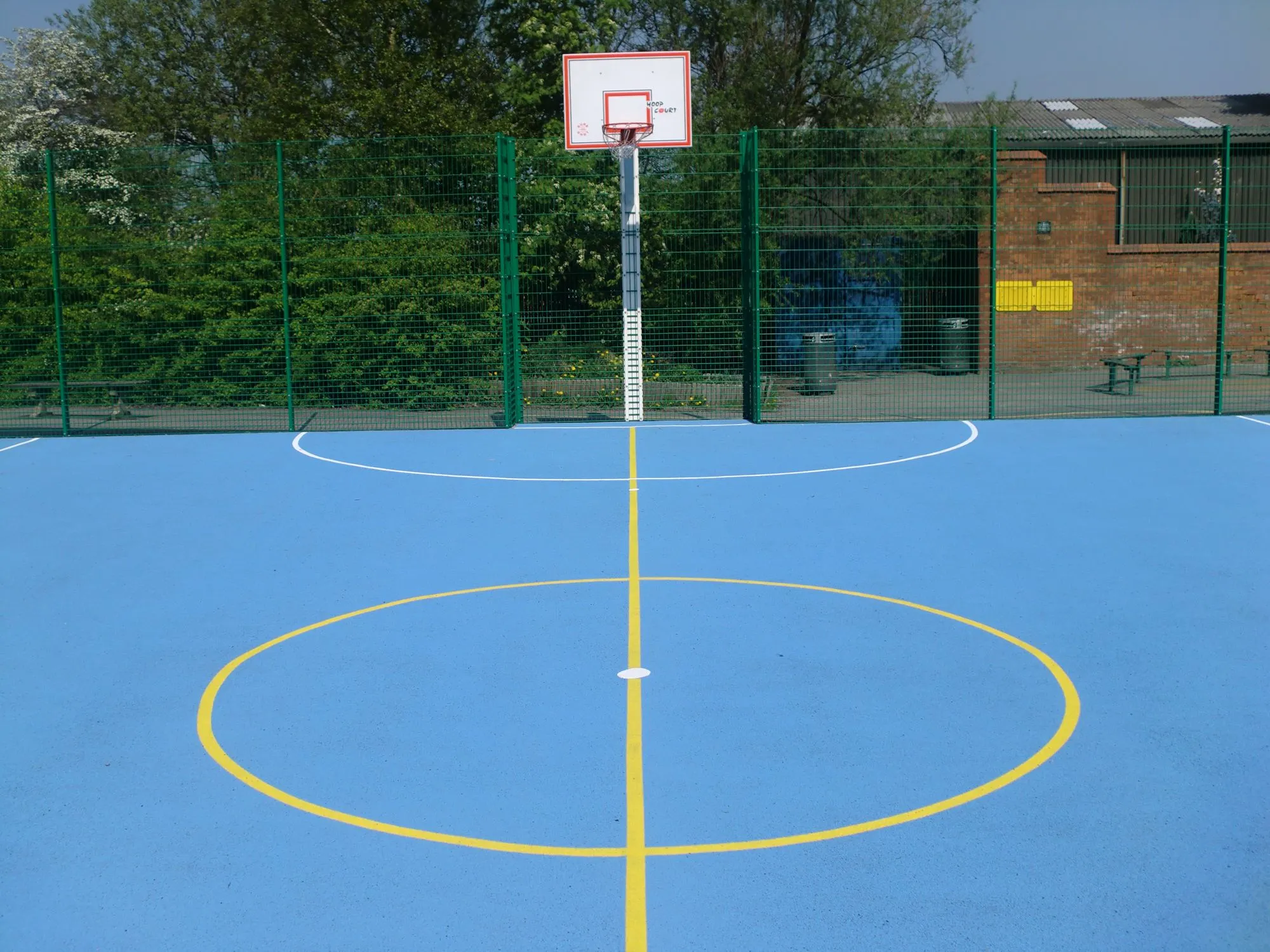
- Preferred outdoor court
- 28 x 15 m (Sport England, 2015)
- Minimum outdoor court
- 26 x 14 m (Sport England, 2015)
- Preferred area with run-offs
- 32.1 x 19.1 m (Sport England, 2015)
- Usual builds
- Porous macadam, or polymeric over macadam (Sport England, 2013)
- Basketball units
- Free-access units fall under BS EN 15312:2026 (BSI, 2026)
- Ring height
- 3,050 mm above the floor (FIBA, 2026)
What material is best for an outdoor basketball court?
Porous macadam and polymeric EPDM rubber over a macadam base are the two hard builds that Sport England’s earlier classification of multi-use courts, historically Types 1 to 5, set out for basketball (Sport England, 2013).
Macadam gives the slip resistance and ball bounce basketball depends on, and it is a hard-wearing, cost-effective choice for school and club courts. Basketball can also be played on a synthetic turf system.
The same classification listed basketball as a secondary sport on its other hard builds: porous macadam with tennis first (Type 1) or netball first (Type 2), and polymeric over macadam with netball first (Type 3). Type 4 put basketball among its main uses, and Sport England did not recommend it for tennis or netball because of its greater shock absorbency and lower surface friction (Sport England, 2013).
Sport England’s earlier MUGA classification and where basketball fits (Sport England, Artificial Surfaces for Outdoor Sport, 2013).
| Build | Historical type | Priority use | Basketball |
|---|---|---|---|
| Porous macadam | Type 1 | Tennis | A secondary sport |
| Porous macadam | Type 2 | Netball | A secondary sport |
| Polymeric over macadam | Type 3 | Netball | A secondary sport |
| Polymeric over macadam | Type 4 | Recreational football, basketball and general play | One of the main uses; the build was not recommended for tennis or netball |
| Artificial grass with a shockpad | Type 5 | Turf sports, on carpets filled or dressed with water, sand or rubber | Not listed |
Sport England now treats the numbered types as an earlier system and groups artificial grass by its pile height and fill instead (Sport England, 2013). How you plan to use the court decides the specification, since a court for competitive matches is built differently from a school practice area.
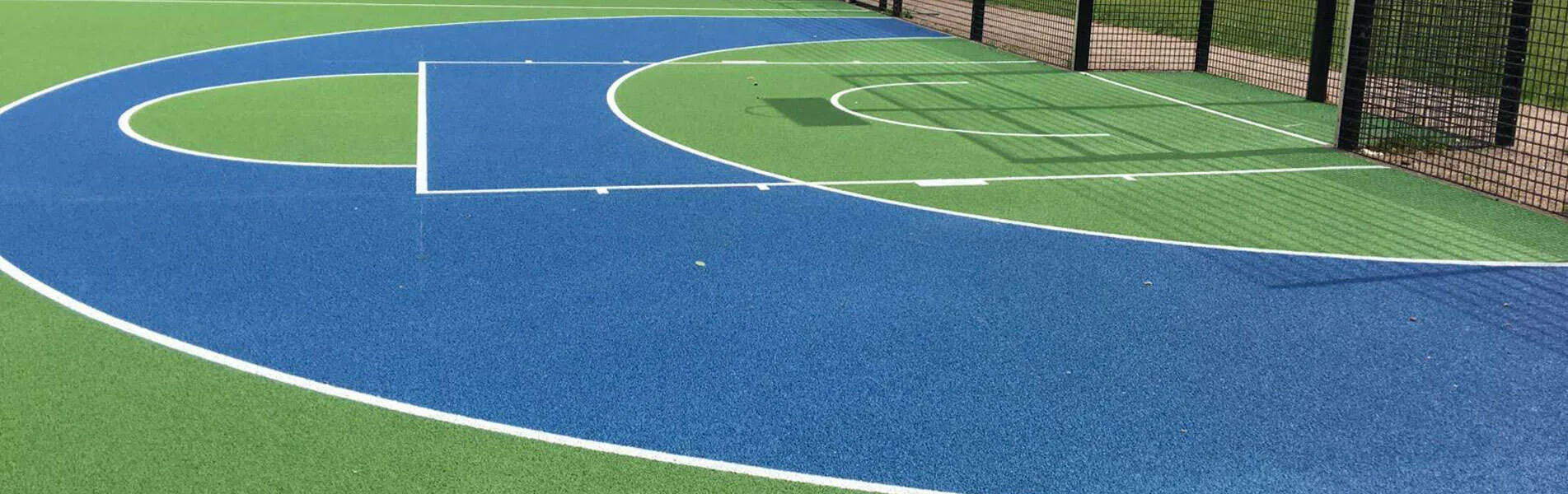
Our pages on porous macadam court surfaces and polymeric sports surfaces explain each build. Call us on 01625 445766 to talk through how your court will be used.
How much would it cost to build a basketball court?
An outdoor basketball court has no published benchmark price, because Sport England’s 3Q2026 facility cost guide, the usual independent figure for sports facilities, has no basketball court line, so the cost of a 28 by 15 metre court comes from a site survey and quote (Sport England, 3Q2026).
Five things set the price of a court:
- The surface. Porous macadam, or polymeric laid on a macadam base, which adds a layer on top (Sport England, 2013).
- The size. From the 26 by 14 metre minimum to the preferred 28 by 15 metres, plus run-offs (Sport England, 2015).
- The site. The condition of the existing area, the access for machinery and, on a job far from us, travel and accommodation. Sport England leaves poor ground and difficult access out of all its benchmarks (Sport England, 3Q2026).
- The fence. Ball stop fencing is priced by the metre run, and the LTA’s 2026 note prices tennis court fencing from £110 a metre for chain link, £130 for weld mesh and £150 for rigid panels (LTA, 2026).
- The equipment. The basketball units, which BS EN 15312:2026 covers when they are free-access, plus any nets and floodlights (BSI, 2026).
If the court will also host netball, tennis or football, our page on Multi-Use Games Area (MUGA) construction gives Sport England’s figure for a fenced, floodlit macadam MUGA.
How can the cost of a basketball court be kept down?
You can keep the cost of a basketball court down by choosing the most cost-effective surface, building a smaller court and simplifying extras such as fencing, nets and floodlights, the trade-offs we talk through when we price a court.
Budget for cleaning and maintenance from the start, because a court that is looked after needs fewer repairs and puts off a resurface, which costs far more. Tell us your budget when you ask us for a free quote, and we will shape the specification around it.
How can an outdoor basketball court be funded?
Grant funding for an outdoor basketball court normally sits alongside the school’s, council’s or club’s own money, and Sport England’s Movement Fund, with grants or pledges from £300 to £15,000, is one scheme to test your project against first (Sport England, 2026).
Its money goes to small-scale improvements to existing facilities, with the applicant owning the site, holding a long lease or having the landlord’s consent. For a facility project, Sport England is likely to offer a pledge that it pays once you raise a matching amount locally (Sport England, 2026).
Sport England’s cost guide has no basketball line, so a written price from us is the figure a bid can be built on. Ask for it before you apply, and the application can ask for the right amount.
Our team helps schools and clubs find grant funding for a basketball court, and the survey records what you hope to raise so the specification matches it.
Contact us once you know which grant you are applying for. The schemes we have checked, and their current status, are listed on our page on funding for sports facilities.
What standards must an outdoor basketball court meet?
An outdoor basketball court’s polymeric surface is covered by BS EN 14877:2013, the British Standard for synthetic surfaces on outdoor sports areas, and a free-access basketball unit on it falls under BS EN 15312:2026, the standard for free access multi-sports equipment (BSI, 2013 and 2026).
BS EN 15312:2026 replaced BS EN 15312:2007+A1:2010, which BSI withdrew on 25 March 2026 (BSI, 2026). Check that any new unit is tested to the current edition.
British Standards that apply to outdoor basketball courts (BSI, read November 2026).
| Standard | Edition | What it covers |
|---|---|---|
| BS EN 14877:2013 | Published 30 September 2013, under review | Synthetic (polymeric) surfaces for outdoor sports areas |
| BS EN 15312:2026 | Published 31 March 2026 | Safety requirements and test methods for free access multi-sports equipment, such as basketball units and goal ends |
| BS EN 12616:2022 | Published 31 March 2023 | Tests for how fast water drains through a sports surface |
| BS EN 13036-4:2011 | Published 31 October 2011, under review | The pendulum slip test, which BSI lists among the references of BS EN 14877 |
A court can only be described as meeting one of these standards when it has the test report to show it. Our page on sports surface standards and certification explains how they are used.
The court’s own markings follow FIBA’s Official Basketball Rules 2026, and our basketball court dimensions guide sets each one out.
What slip resistance does a basketball court need?
An outdoor basketball court needs a coating with enough grip for quick stops and changes of direction, so we test slip resistance with the pendulum test and adjust the coating’s grit until the court reaches the figure set for the sport.
The grip comes from an aggregate mixed into the paint, and the amount and concentration of that paint decide where the reading lands. A netball court needs more grip again, 75 or more on the pendulum test for England Netball certification (England Netball, 2025).
Does an outdoor basketball court need planning permission?
In England, your local planning authority decides whether a new outdoor basketball court can go ahead, and if it would use part of a playing field, for example a school field with pitches marked on it, the authority has to consult Sport England first (Development Management Procedure Order 2015).
Adding floodlights widens that. England’s Planning Practice Guidance advises consulting Sport England on lighting a major outdoor sports facility, and Sport England wants new or upgraded lighting on a playing field or MUGA referred to it as a statutory consultee (Sport England, 2026).
In England, planning permission is also needed for a fence above 2 metres, or above 1 metre beside a road (Planning Portal; General Permitted Development Order 2015), so check the height of the ball stop fence early; see ball stop fencing.
Elsewhere in the UK, check with your local planning authority.
For resurfacing an existing court, the LTA’s tennis guidance is a useful pointer: resurfacing does not normally need planning consent unless the construction, the colour or the level changes (LTA, 2026).
How is a basketball court constructed?
A basketball court is constructed on a compacted stone base topped with porous macadam, or with polymeric over the macadam, as in Types 1 to 4 of Sport England’s earlier classification, and set out to the preferred outdoor size of 28 by 15 metres (Sport England, 2013 and 2015).
- Survey. We measure up on site and check access, the space available, the budget and any funding.
- Dig out. The ground is excavated to the depth the build needs.
- Stone base. A compacted stone sub-base goes down across the court and its run-offs, 32.1 by 19.1 metres overall in Sport England’s preferred layout (Sport England, 2015).
- Surface. Macadam is laid straight onto the stone. A polymeric court needs that macadam layer first, with the rubber laid on top (Sport England, 2013).
- Coating and lines. An anti-slip coating, then the basketball markings; see basketball court line marking.
- Units and fencing. Free-access basketball units, which BS EN 15312:2026 covers, and a ball stop fence around the court (BSI, 2026).
Our macadam basketball courts are built in two layers on a compacted MOT Type 1 stone base, and the depth and aggregate of each layer are set out on our page about porous macadam court construction.
How is a basketball court painted and lined?
We coat a macadam basketball court in an acrylic anti-slip paint, and a polymeric court in polyurethane where that suits it better, then mark the sports lines in a contrasting colour such as white, so they stand out and the game is played accurately.
The paint carries an aggregate for grip, and it stays porous, so rain still drains through and the court keeps its all-weather use. For a school, that anti-slip finish makes the court safer for the children who play on it.
We mark lines in white, blue, red or yellow, and we can lay out a full court or a half court. Extra markings for other sports go on in contrasting colours, which turns the court into a multi-use games area.
For a specification to put out to tender or into a funding bid, see our consultancy service. Get in touch to arrange a site visit before the layout is fixed.
How long does an outdoor basketball court last?
The closest published lifespan for an outdoor basketball court is the LTA’s figure for a porous macadam tennis court, which typically lasts 10 to 12 years with a repaint every 5 years and a new surface every 8 to 10 (LTA, 2026).
For budgeting, Sport England’s life cycle model for a multi-use court sets aside 1.4% of the project cost each year as a sinking fund and 0.4% for maintenance (Sport England life cycle costs, 2Q2023). The LTA’s upkeep list for a macadam court is regular sweeping, power washing now and then, and moss and weed killer when needed (LTA, 2026).
What does basketball court maintenance involve?
Basketball court maintenance is proactive work that keeps the court clean, such as deep cleaning, pressure washing and regular brushing, followed by reactive work on problems that have already appeared, from faded lines to tears and holes in the surface.
Dirt, twigs, leaves and mud all spoil how a court plays, and a moss and algae treatment on a macadam or polymeric court stops growth taking hold. For reactive work we re-line faded markings, repair holes and, where a court is in very bad condition, resurface it.
Maintenance costs rise with the size of the court, since a bigger court takes longer and a two-day job adds accommodation. A moss treatment over a large area also needs more agent.
How is an outdoor basketball court cleaned?
We clean an outdoor basketball court with a jet wash that clears debris and cuts the chance of moss growth or waterlogging, and we recommend brushing the court routinely in between to clear any leaves or mud that settle.
Pools of water on the surface are the easiest sign of trouble, because moss and algae clog the pores so rain cannot pass through. A deep clean also takes out slippery areas, which matters most on a court you rent out to the public.
A court that has become badly contaminated may need a refurbishment to bring its playing qualities back. Cleaning works on polymeric rubber and porous tarmac alike, and the bigger the court, the more water and cleaning agent it takes.
How are basketball court repairs carried out?
We repair a basketball court by patching holes and damaged areas and by repainting and re-lining it in anti-slip coatings, the work that restores a court worn by heavy use, vandalism or a lack of cleaning.
Without regular maintenance a court loses its drainage, floods in wet weather and loses its anti-slip grip. Repairs made early cost far less than the resurface a neglected court ends up needing.
What size is an outdoor basketball court?
An outdoor basketball court measures 28 by 15 metres in Sport England’s preferred size, or 26 by 14 metres at minimum, and its 2015 guide gives a preferred overall area of 32.1 by 19.1 metres including run-offs (Sport England, 2015).
The run-off around the court is 2.05 metres in the preferred layout and 1.05 metres at minimum, which makes a minimum overall area of 28.1 by 16.1 metres (Sport England, 2015). A half court measures 13 by 14 metres, and Sport England notes that outdoor basketball is played only at community level (Sport England, 2015).
FIBA’s rules give a full-size court as 28 by 15 metres measured to the inside edge of the boundary line, with 5 cm lines and the ring 3,050 mm above the floor (FIBA, 2026). Basketball England requires the same size and line width for indoor courts in its national leagues (Basketball England, 2026).
For indoor multi-sport venues, Basketball England recommends laying the basketball lines on top of the other sports’ markings where possible (Basketball England, 2026). On outdoor multi-use courts, we mark the basketball lines in red or blue.
Our basketball court dimensions guide sets out each size with its run-offs and compares them with netball and tennis courts.
Why choose Sports and Safety Surfaces for an outdoor basketball court?
At Sports and Safety Surfaces, we build, paint, line, clean, repair and resurface outdoor basketball courts and fit the fencing around them, so a school, college, club or leisure centre deals with one contractor from the first site visit onwards.
Our basketball work ranges from new courts and multi-use games areas to improving an existing court with a fresh coating and new lines. Secondary schools and leisure centres are among the places we build for.
A selection of our Google reviews sits at the foot of this page, in our customers’ own words.
Frequently asked questions
Can an outdoor basketball court be painted in team colours?
Yes, we offer a large choice of colours, so a sports club or a school with a competitive team can have the court painted in its own team colours, with the lines picked out in a contrasting shade.
Can a basketball court double as a netball and tennis court?
Yes, a Type 2 macadam court or a Type 3 polymeric court suits netball and tennis as well as basketball, because Sport England’s earlier classification listed all three sports on both builds (Sport England, 2013). We add each sport’s lines in a contrasting colour, which turns the court into a multi-use games area.
How high is the fence around an outdoor basketball court?
The ball stop fence around a basketball court is usually a 3 metre rebound fence, with the hoop often built into it. The height can change with the other sports on the court, such as football, netball or tennis.
Does an outdoor basketball court need floodlights?
Floodlights are optional on a basketball court. They let the court be used after daylight, which helps if you plan to hire it out, and leaving them out is one way to keep the build cost down.
Sport England lists 75, 200 and 500 lux for Class III, II and I outdoor basketball (Sport England, 2026); see sports floodlights.
Get a free quote for an outdoor basketball court
Send us the area size, your postcode and your budget, and we will prepare a quote around them.
Call us on 01625 445766 or request a free quote, and we will arrange to measure up.
Testimonials
A selection of our Google reviews, posted over several years and quoted word for word. Google shows each review's date. Rating as shown on Google on 16 November 2026.
We had our 2 of our tennis courts rejuvenated by Sports and safety services June 2022. They did a great job and we are very happy with services they provided. Will use them again and would recommend to others. Pete Emsell Chairman Huddersfield Lawn Tennis and Squash club
They installed a sports track at my kids school and as a committee member we were involved in the selection process, can highly recommend these guys, top job from start to finish.
I am the secretary of our local junior football club. We needed an area the teams could train during the bad weather and not ruin the pitches.
Spoke with several companies and these were by far the most professional and answered all the questions I had, which put my mind at ease.
Now the teams have somewhere to train during the winter months which can only be beneficial to their development.
They are a really helpful company with an eye for attention to details while offering good value for money. They are keen to encourage UK commerce and go the extra mile to make sure the customer needs are met. The projects they have completed for me have all been on time and more importantly with budget!
The sports surfaces installed to the MUGAs was an amazing upgrade to the existing surfacing. I would definitely use these again on sport surfacing to ball courts in the UK
Uk sports surfaces contractor who have constructed, surfaced and maintained many sport all weather courts for us.
Get a free quote
© OpenStreetMap contributors
Need more information?