
Netball court dimensions and markings
A netball court measures 30.5 by 15.25 metres with a 3.05 metre surround, about 465 square metres of court, and Sport England's 2015 guide gives a community court 34.5 by 18.25 metres overall.
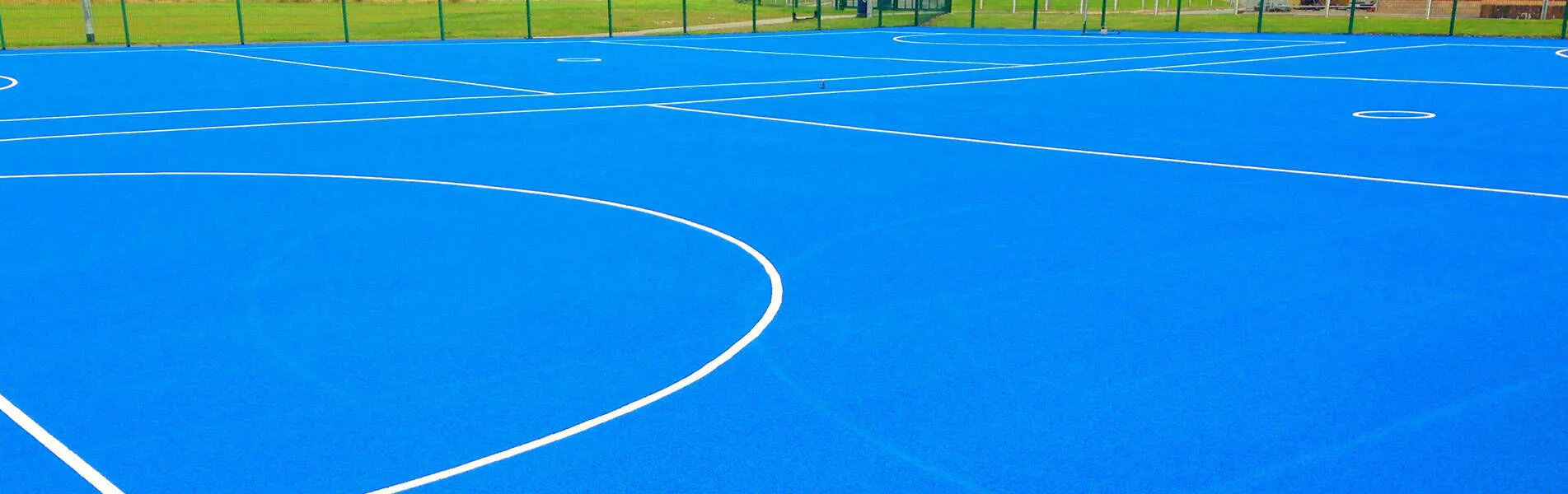
- Court
- 30.5 x 15.25 m (World Netball, 2026)
- Court surround
- 3.05 m (World Netball, 2026)
- Community court with run-offs
- 34.5 x 18.25 m (Sport England, 2015)
- Club court with run-offs, preferred
- 36.6 x 21.35 to 23.35 m (Sport England, 2015)
- Lines
- 50 mm wide and part of the court (World Netball, 2026)
- Goalpost and ring
- 3.05 m post, 380 mm ring (World Netball, 2026)
What are the dimensions of a netball court in the UK?
A UK netball court measures 30.5 by 15.25 metres, set by World Netball, with 50 millimetre lines that count as part of the court and a 3.05 metre surround, and Sport England’s 2015 guide adds the run-offs that make up its overall area (World Netball, 2026; Sport England, 2015).
The court is the same size whatever the level of play. What changes from a community court to a club court is the space around it, and that space decides how much ground you need.
At Sports and Safety Surfaces, we design netball courts to suit the space each school or club has, in a range of surfaces and specifications. Call us on 01625 445766 if you are not sure a court will fit your site.
Sport England’s comparative sizes guide was published in 2015, so check its overall areas against England Netball’s current guidance before you fix a layout.
What size is a netball court at each level of play?
Run-off is what grows with the level of play: a community court has 1.5 metres at the sides and 2.0 metres at the ends, and a club court has 3.05 metres on every side, which takes its preferred overall area to 36.6 by 21.35 to 23.35 metres (Sport England, 2015).
Outdoor netball court areas by level of play (Sport England Comparative Sizes, 2015; square metres are our arithmetic).
| Level | Court | Run-off | Overall area | Square metres |
|---|---|---|---|---|
| Community | 30.5 x 15.25 m | 1.5 m at the sides, 2.0 m at the ends | 34.5 x 18.25 m | about 630 |
| Club, minimum | 30.5 x 15.25 m | Within the overall area shown | 34.5 x 18.25 to 20.25 m | about 630 to 699 |
| Club, preferred | 30.5 x 15.25 m | 3.05 m on every side | 36.6 x 21.35 to 23.35 m | about 781 to 855 |
England Netball sorts courts into four facility categories, and its two higher categories sit above club level (England Netball, 2025). The outdoor areas in the table cover community and club courts.
How much space does a netball court need including run-offs?
A community netball court needs run-offs of 1.5 metres at the sides and 2.0 metres at the ends, which makes 34.5 by 18.25 metres overall, and Sport England’s 2015 guide prefers 3.05 metres on every side for a club court (Sport England, 2015).
That 3.05 metres matches the court surround World Netball gives (World Netball, 2026). A club court built to the preferred size therefore has its full surround on all four sides.
Keep the run-off clear when you site benches, bins or storage. A covered court also needs height, with at least 7.5 metres of clear height under the roof (Sport England, 2015).
What size of netball court should we build?
The netball court to build is set by its level of play and by any roof, a community court needs 34.5 by 18.25 metres overall, and a covered court needs at least 7.5 metres of clear height (Sport England, 2015).
For a club court, aim for the preferred 36.6 by 21.35 metres if the ground allows it, which gives the full 3.05 metre run-off all round (Sport England, 2015). That footprint is also the size of the macadam Multi-Use Games Area (MUGA) that Sport England prices at £195,000, fenced and floodlit, excluding VAT (Sport England, 3Q2026).
It is about the same length as the LTA’s recommended block for one tennis court, 36.58 by 18.29 metres, and about 3 metres wider (LTA, 2026). That matters if the court will be shared with tennis.
Our team measures up on site and checks the space and the access before a layout is drawn. Get in touch to arrange a site visit, and our page on netball court construction explains the build.
Which surface should a netball court be built on?
Two surfaces carry most netball courts: porous macadam on a stone sub-base, finished in an acrylic anti-slip coating, and polymeric EPDM rubber crumb bound with a binder and poured onto a macadam base, finished in a polyurethane non-slip coating.
Those two builds match Types 2 and 3 in Sport England’s earlier classification of multi-use courts, which put netball first on both (Sport England, 2013). England Netball lists both among its outdoor surfaces (England Netball, 2025).
The coating on each gives the slip resistance netball needs. Our netball court construction page compares all four outdoor surfaces.
How many m2 is a netball court?
A netball court covers about 465 square metres, from World Netball’s 30.5 by 15.25 metres, and a community court’s whole outdoor area of 34.5 by 18.25 metres comes to about 630 square metres (our arithmetic from World Netball, 2026 and Sport England, 2015).
A club court built to Sport England’s preferred size needs between about 781 and 855 square metres overall, depending on the width chosen (our arithmetic from Sport England, 2015).
What are the markings and line widths on a netball court?
Netball court markings are 50 millimetre lines that count as part of the court, with two transverse lines dividing it into three equal thirds and a goal circle of 4.9 metres radius at each end, per World Netball (World Netball, 2026).
Netball court markings and fittings (World Netball, Facilities and Equipment, read November 2026).
| Marking or fitting | Measurement |
|---|---|
| Court | 30.5 x 15.25 m |
| Lines | 50 mm wide, part of the court |
| Transverse lines | Two, dividing the court into three equal thirds |
| Goal circle | 4.9 m radius at each end |
| Court surround | 3.05 m |
| Goalpost | 3.05 m high, 65 to 100 mm in diameter |
| Ring | 380 mm internal diameter, made from 15 mm steel rod |
On a court shared with other sports, the netball lines sit among the lines for tennis or basketball, so each sport is painted in its own colour.
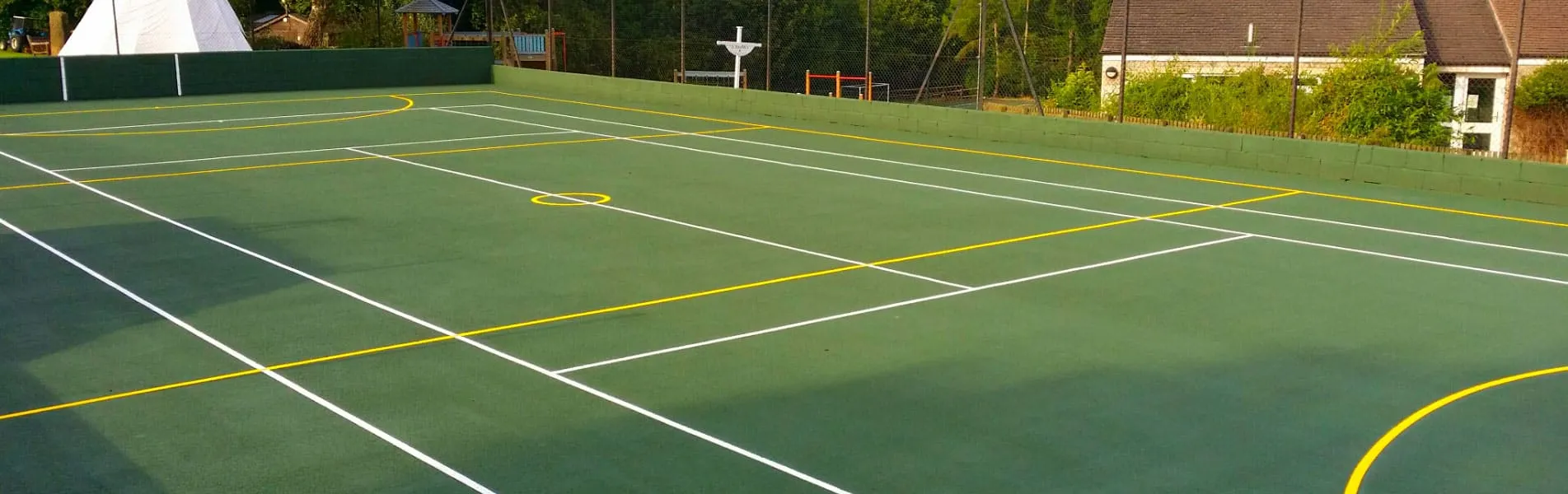
For new markings or a repaint, contact us about netball court line marking.
How many thirds are on a netball court?
A netball court has three thirds: World Netball’s two transverse lines divide the 30.5 by 15.25 metre court into three equal areas, each about 10.2 metres long, and those lines count as part of the court (World Netball, 2026; the length of each third is our arithmetic).
Are the lines part of a netball court?
Yes, the lines are part of a netball court: World Netball sets them at 50 millimetres wide and counts them within the court area they outline, including the two transverse lines that create the thirds (World Netball, 2026).
Because the lines are part of the court, the 30.5 by 15.25 metres includes them (World Netball, 2026). The court has to be set out with that in mind when it is marked.
What height should a netball ring be?
A netball ring sits at the top of a goalpost 3.05 metres high, and World Netball specifies a ring of 380 millimetres internal diameter, made from 15 millimetre steel rod, on a post 65 to 100 millimetres in diameter (World Netball, 2026).
The posts and rings go in as part of a new court. Our page on netball court construction sets out the full build.
How does a netball court compare with other pitches and courts?
A netball court, at 30.5 by 15.25 metres, is bigger than Sport England’s preferred 28 by 15 metre outdoor basketball court and bigger again than a 23.77 by 10.97 metre doubles tennis court (World Netball, 2026; Sport England, 2015; LTA, 2026).
Court sizes compared (World Netball, 2026; Sport England, 2015 and 3Q2026; LTA, 2026; square metres are our arithmetic).
| Court | Size | Square metres | Source |
|---|---|---|---|
| Netball | 30.5 x 15.25 m | about 465 | World Netball, 2026 |
| Outdoor basketball, preferred | 28 x 15 m | 420 | Sport England, 2015 |
| Outdoor basketball, minimum | 26 x 14 m | 364 | Sport England, 2015 |
| Tennis, doubles | 23.77 x 10.97 m | about 261 | LTA, 2026 |
| Multi-Use Games Area (MUGA), as priced by Sport England, overall area | 36.60 x 21.35 m | 782 | Sport England, 3Q2026 |
Which is bigger, a netball court or a basketball court?
A netball court is the bigger of the two, because at 30.5 by 15.25 metres it is 2.5 metres longer and 0.25 metres wider than Sport England’s preferred 28 by 15 metre outdoor basketball court (World Netball, 2026; Sport England, 2015).
The run-offs change the picture a little. A community netball court takes 34.5 by 18.25 metres overall, while a preferred basketball court takes 32.1 by 19.1 metres, so the basketball area is shorter but wider (Sport England, 2015).
Our basketball court dimensions guide has the full figures.
Frequently asked questions
Can a netball court be built smaller for recreational play?
Yes, a court used only for recreational games can be built smaller to fit the space a school or club has. A court for matches needs World Netball’s full 30.5 by 15.25 metres, with its 3.05 metre surround (World Netball, 2026).
Can a netball court be marked for tennis and basketball too?
Yes, both netball surfaces, macadam and polymeric, also suit basketball and tennis. We add each sport’s lines in a contrasting non-slip paint, so players can follow their own markings and score accurately.
Can fencing and floodlights be fitted around a netball court?
Yes, fencing and floodlights are fitted to suit the court size you choose. A ball stop fence keeps play on the court, and floodlights let it be used after daylight hours.
Sport England lists 75, 200 and 500 lux for Class III, II and I outdoor netball, and records AENA’s 400 lux for competitive play (Sport England, 2026); see sports floodlights.
Book a site survey for a netball court
A site survey settles the size of court your ground can take: we measure up, check the access and the levels, and set the court and its run-offs out around how you will use it.
Call us on 01625 445766 to book a site survey, or ask us for a free quote once the layout is agreed. Our page on netball court construction covers the surfaces, the build and the costs.
Get a free quote
© OpenStreetMap contributors
Need more information?