
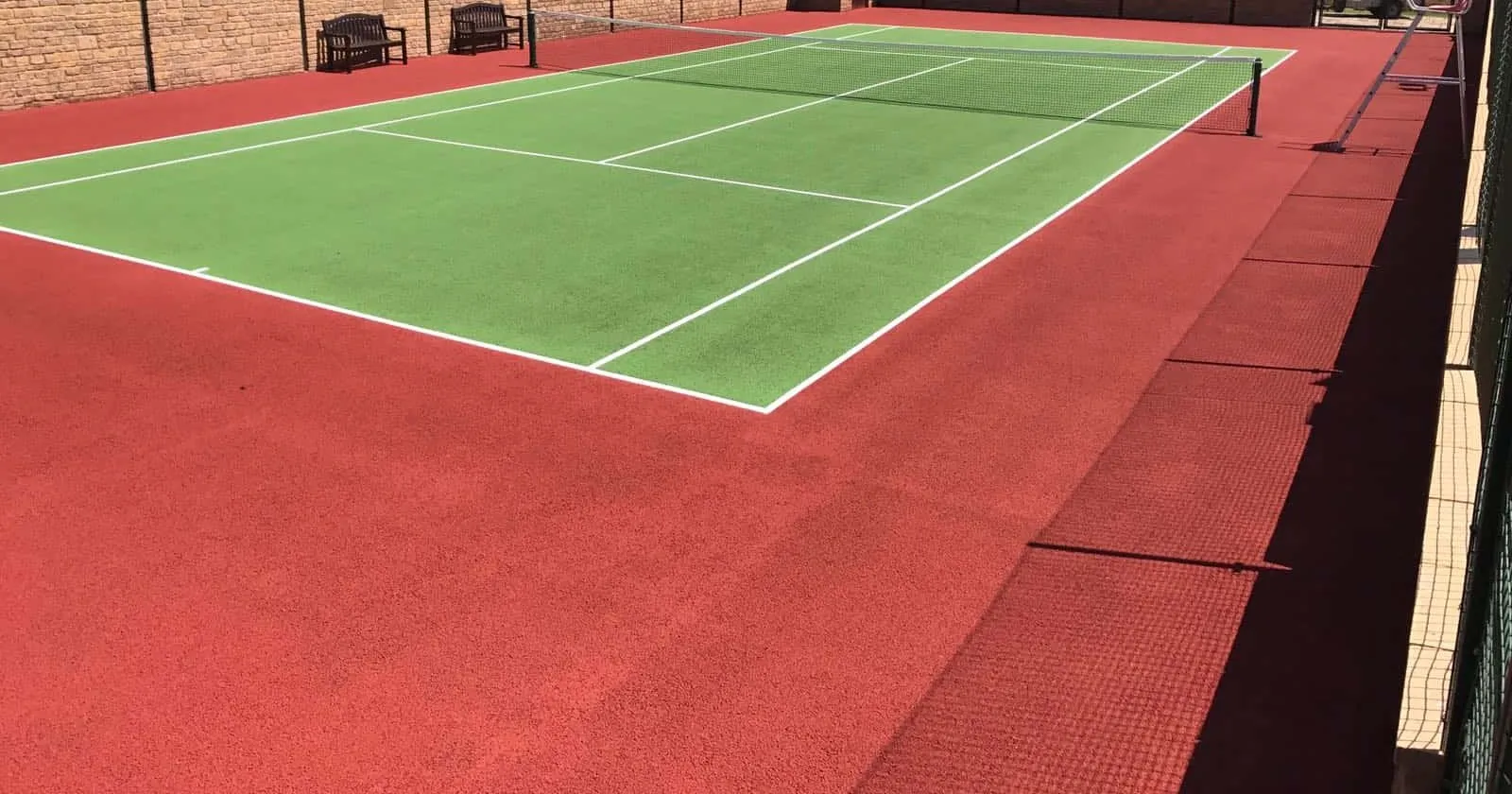
Tennis court maintenance in Cardiff: a clean, moss treatment and repaint
TennisPorous macadam
Tennis court cleaning keeps a macadam court free from moss and algae through regular sweeping, periodic power washing and moss and weed killer when needed, the routine the LTA's 2026 guidance sets out.
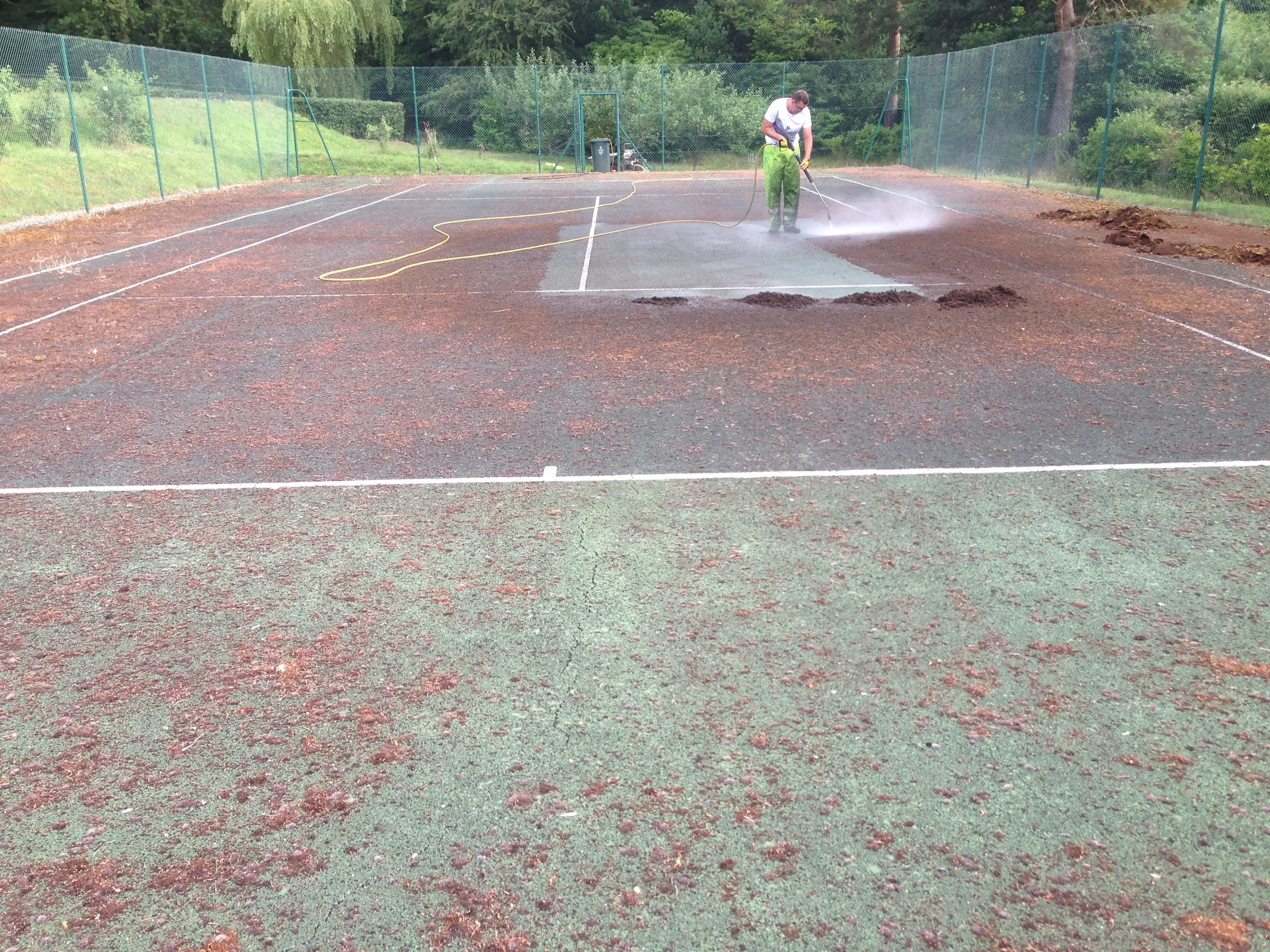
At Sports and Safety Surfaces, we clean tennis courts once a year as standard, in line with the LTA’s 2026 guidance to sweep or vacuum a macadam court regularly, power wash it periodically and check artificial grass and clay courts for moss and algae every 6 months (LTA, 2026).
A court shaded by trees may need cleaning twice a year, because leaves, litter and damp let moss grow faster. Artificial grass and artificial clay courts also need a moss and algae treatment over the whole court once a year (LTA, 2026).
What a tennis court clean looks for and does, with the LTA’s intervals (LTA Porous Court Surfaces Guidance Note, 2026).
| What the cleaner looks for | What the clean does | How often | Surface |
|---|---|---|---|
| Leaves, litter and loose dirt lying on the court | Swept or vacuumed off before it works into the pores | Regularly | Porous macadam |
| Dirt and moss held in the pores, and a court that feels slippery | Pressure washed with a court cleaning solution | Periodically | Porous macadam |
| Moss and weeds coming back after the wash | Treated with a moss and weed killer | When needed | Porous macadam |
| Green patches of moss and algae in the carpet or infill | Checked across the whole court | Every 6 months | Artificial grass and artificial clay |
| Moss and algae spread across the surface | Treated over the whole court | Once a year | Artificial grass and artificial clay |
Regular cleaning makes a court last longer and pays for itself. A clean court needs its colour coat and lines renewed less often, while a neglected one needs painting, binding and resurfacing much sooner.
If your court is turning green, call us on 01625 445766. For the whole picture of looking after a court through its life, see tennis court construction.
A moss and weed killer, applied when moss appears, is what the LTA’s 2026 guidance lists for porous macadam tennis courts, and for artificial grass and clay courts it recommends a moss and algae treatment over the whole court once a year (LTA, 2026).
On macadam and polymeric courts, we use Moss Court Pro, a concentrated biocide whose active ingredients include quaternary ammonium chloride. It controls moss, algae, bacteria and lichens, so the surface keeps its porosity and goes on draining in wet weather.
The treatment goes on after the clean, mixed with water and sprayed or brushed into the surface. We keep the spray and any run-off away from lawns, plants and other grass, which it can damage.
Cleaning a single tennis court takes about 1 to 2 days, and the court can be played on straight away afterwards, so fixtures and lessons lose very little time.
Cleaning a tennis court costs far less than the LTA’s figure of about £15,000 to £20,000 per court for a repaint or a new layer of macadam, and we price each clean on the court’s size, condition, surface and location (LTA, 2026).
The LTA’s guidance gives no cleaning price of its own. A court with heavy moss, or one that is used and hired out often, costs more to keep clean than a lightly used one.
Regular cleaning keeps later costs down, because a court that is looked after needs fewer repairs and a resurface much later. A well-kept court can also be hired out to local clubs in all weathers, which helps pay for its upkeep.
Where a clean is part of larger works, our page on funding for sports facilities explains the grant schemes. Send us photos of the court, its size and its postcode, and ask us for a free quote.
We price most cleaning and repair work from photos and the court’s location. We measure the court from aerial mapping, then estimate the visible repairs from your photos, priced by the square metre.
Our quotes usually include a binder coat as an extra, for courts that are fretting, unless you tell us you do not want one. Some damage only shows once the court is clean, so if we find more repairs than we priced, we show you the court and agree what to do before we carry on.
Where a macadam court is over 20 years old and needs a lot of repairs, a new wearing course is usually the better buy. If the budget will not stretch to that, we help you pick the repairs that matter most.
A cleaning quote should name the cleaning chemical, because water on its own does not shift grease and dirt. Compare like with like on every quote, and check the contractor’s credit history so you know they will still be trading if anything needs putting right.
Moss, algae and dirt on the surface are the signs a tennis court needs cleaning, and the LTA’s 2026 guidance asks owners to keep macadam courts clean and free from moss and algae and to check artificial grass and clay courts for both every 6 months (LTA, 2026).
What to look for:
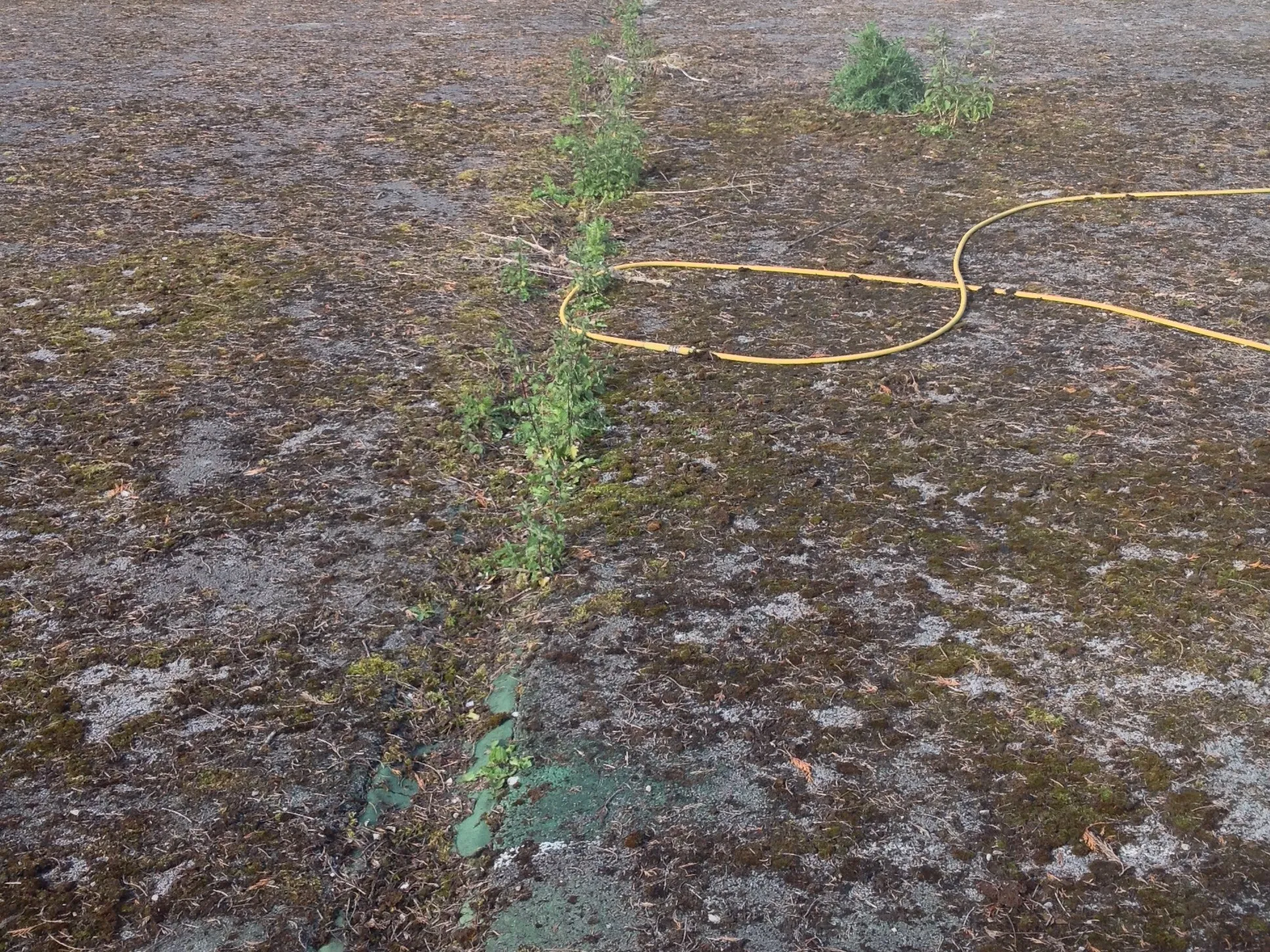
If you can see any of these, get in touch before the problem spreads.
Leaves, litter and mud left lying on a court rot down in its pores and clog them. As a macadam court ages, fine material clogs its open-graded surface until it holds water like a solid floor.
Standing water then feeds more moss and algae, which makes the court slippery and unsafe. Clearing the pores early stops the drainage problem from spreading.
A court has to be fully clean before it is recoloured or re-lined, because paint laid over dirt washes off with it. A thorough clean is what lets a new anti-slip coating and new lines last.
On a multi-sport court, each sport’s lines usually go down in their own colour, such as white for football, yellow for netball and red or blue for basketball. The coating can be a polyurethane finish, a water-based or acrylic coating, or a moisture-curing coating.
A court that is only dirty often needs nothing more than the clean, but fretting and very poor drainage call for repairs, a binder coat and new anti-slip paint. A court that has turned slippery can also be given a non-slip coating.
We fill cracks and holes in macadam with 2 mm emerald stone, an angular stone that locks together and still lets water drain through. We also repair artificial grass carpet that has ripped or pulled away from its base, as covered on our tennis court resurfacing and tennis court painting pages.
Pressure washing is fine for a porous macadam or polymeric tennis court, and the LTA’s 2026 guidance lists periodic power washing alongside regular sweeping or vacuuming and moss and weed killer as the way to keep a macadam court clean (LTA, 2026).
It is also a low-cost fix for a court that has lost its grip to mildew and dirt.
The method matters. A driveway cleaner, or a jet washer aimed straight down at high power, loosens stones in macadam and causes the fretting that leads to a resurface.
We spray a court cleaning solution onto the surface and wash it from an angle, which reaches each side of the macadam stones with less impact than a jet aimed straight down. We work across the whole court in two directions, so dirt is lifted from every side.
On a large area we may use a high-pressure rotary cleaner, and a fungicidal wash follows to slow regrowth. Washing lifts moss, leaves, mud, grime, chewing gum, mould and loose paint, and leaves the court ready for a new coating.
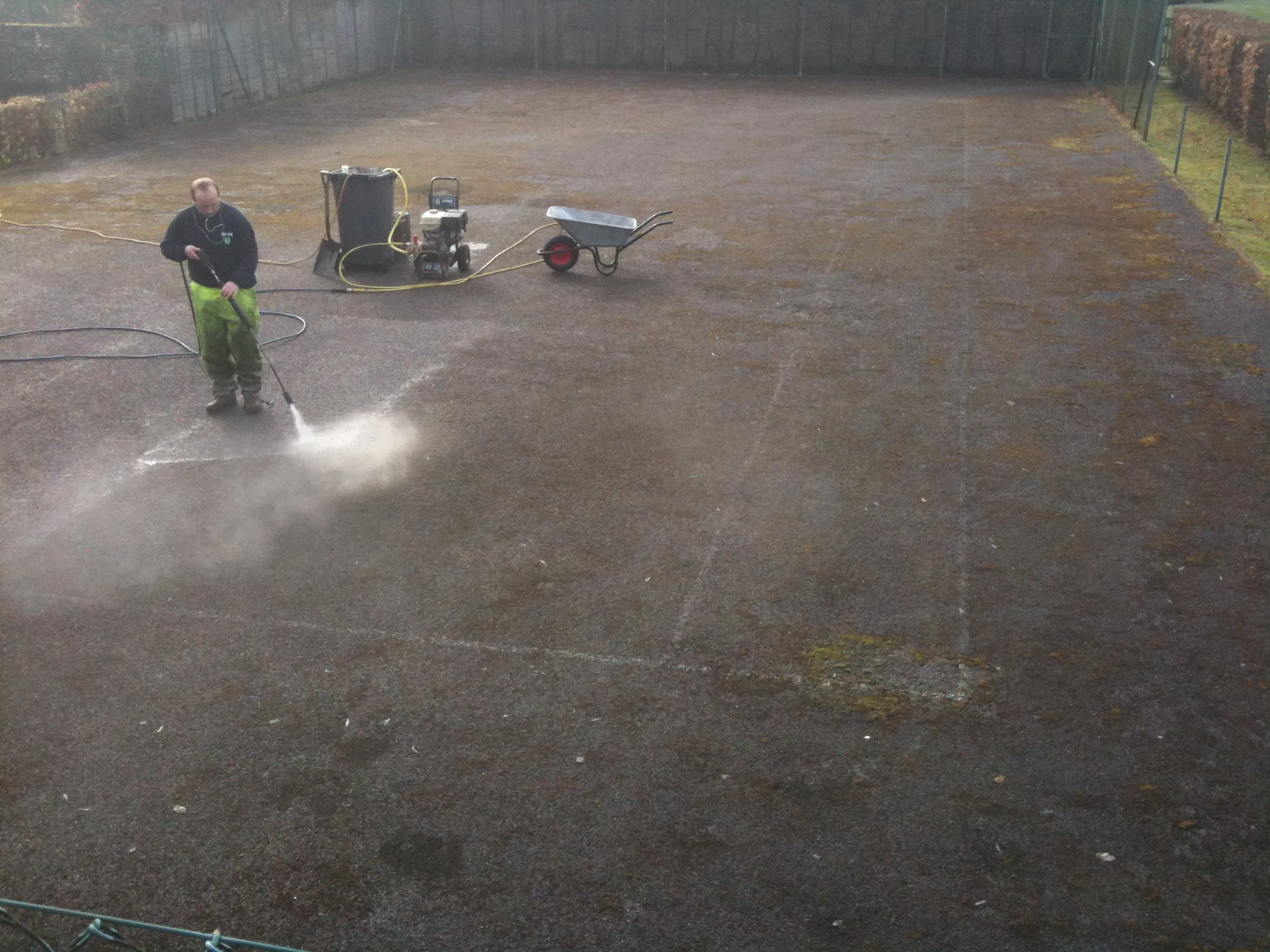
The Pro Tennis Cleaning Solution we use is based on anionic and non-ionic surfactants, the detergents that let water mix with grease and dirt. Each surfactant molecule has a head that holds onto water and a tail that holds onto dirt, so the dirt lifts away when the court is washed.
The solution also carries bactericides and preservatives. These stop bacteria taking hold on the surface, which matters most on damp courts shaded by trees or buildings.
A polymeric (EPDM rubber) court is cleaned much like macadam, with a pressure wash, a cleaning solution and a moss and algae treatment, and both need brushing between visits. A sand-filled or multi-sport artificial grass court is drag-brushed instead, which lifts out dirt and spreads the sand evenly.
If an artificial grass court is badly contaminated with moss, we rejuvenate it by extracting the dirty sand and putting down a fresh layer. Four of our own court cleaning jobs, each followed by a new colour coat, are among our case studies, and a selection of our Google reviews sits at the foot of this page in our customers’ own words.
Yes, for the routine part: sweeping, brushing and clearing leaves are jobs a club or school can do every week. Leave the pressure washing to a contractor, because a driveway cleaner or a straight-down jet can damage the macadam.
Yes, a court can be played on as soon as the clean is finished. A new colour coat or new lines need their own drying time, so if the court is being repainted as well, ask us for the full programme.
Two-tone greens were the classic choice because they blend with the surroundings, and two-tone blues followed. Clubs now pick purple, red, grey, blue or green in contrasting pairs, and extra lines in other colours can turn the court into a multi-use games area.
Yes, we clean multi-use games areas and all-weather courts in the same way. We also carry out patch repairs, goal recess and floodlight repairs, and new anti-slip coatings, so one visit can cover more than the clean.
Send us photos of the court and its postcode, and we will measure it from aerial mapping and price the clean and any repairs we can see.
Call us on 01625 445766 or request a free quote, and tell us whether the court is shaded by trees.
TennisPorous macadam
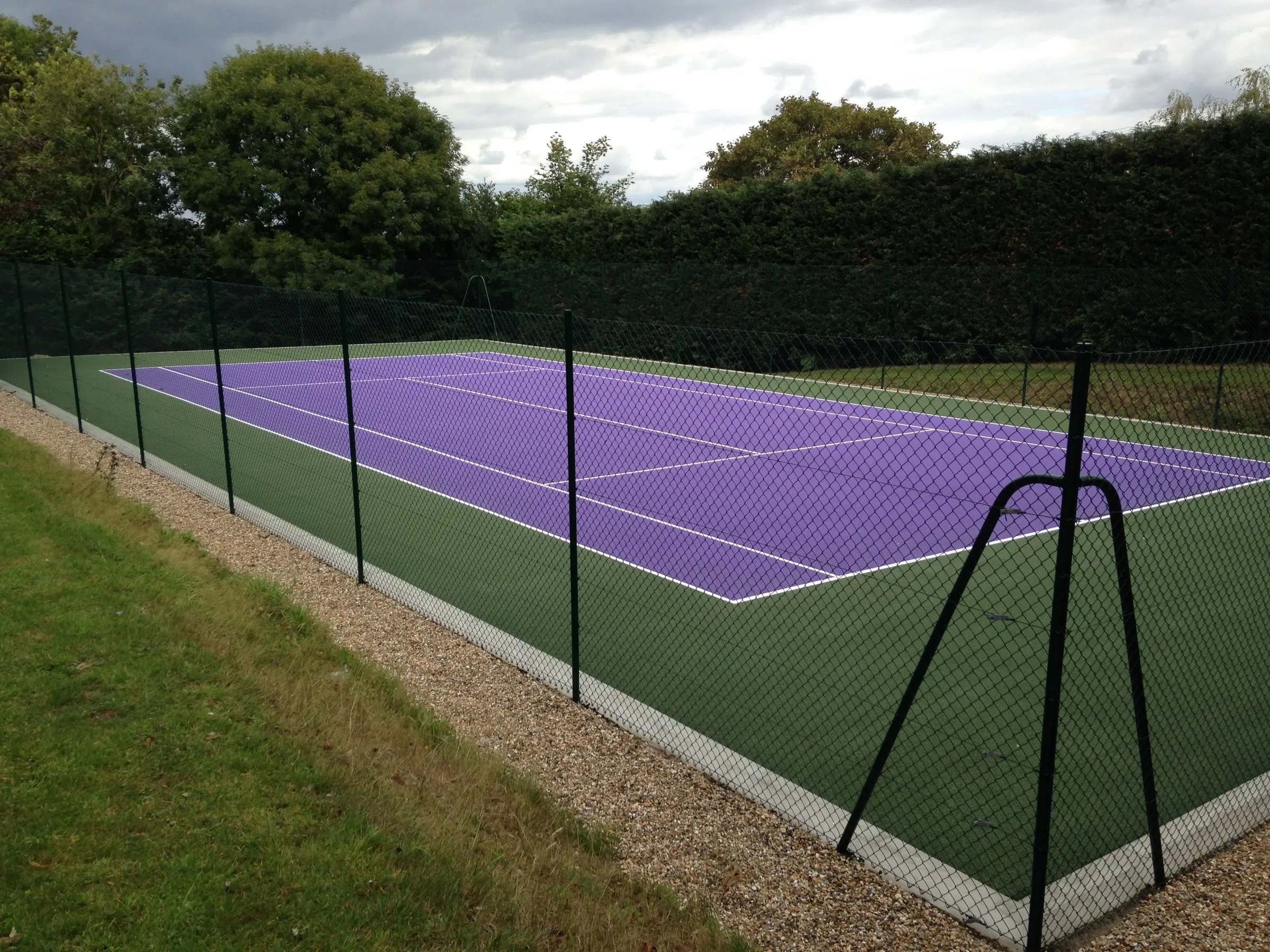
TennisPorous macadam
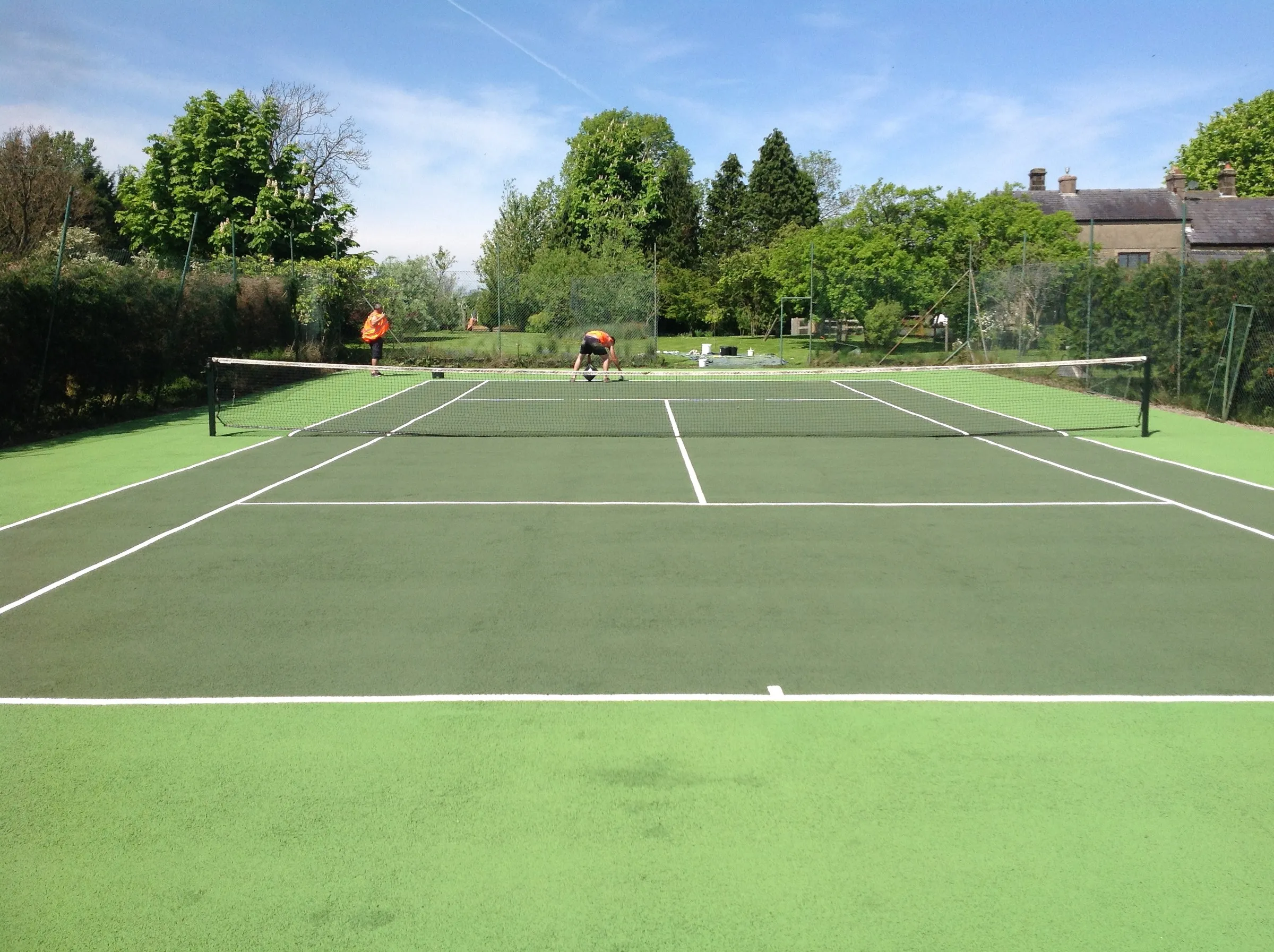
TennisPorous macadam
TennisPorous macadam
A selection of our Google reviews, posted over several years and quoted word for word. Google shows each review's date. Rating as shown on Google on 16 November 2026.
We had our 2 of our tennis courts rejuvenated by Sports and safety services June 2022. They did a great job and we are very happy with services they provided. Will use them again and would recommend to others. Pete Emsell Chairman Huddersfield Lawn Tennis and Squash club
They installed a sports track at my kids school and as a committee member we were involved in the selection process, can highly recommend these guys, top job from start to finish.
I am the secretary of our local junior football club. We needed an area the teams could train during the bad weather and not ruin the pitches.
Spoke with several companies and these were by far the most professional and answered all the questions I had, which put my mind at ease.
Now the teams have somewhere to train during the winter months which can only be beneficial to their development.
They are a really helpful company with an eye for attention to details while offering good value for money. They are keen to encourage UK commerce and go the extra mile to make sure the customer needs are met. The projects they have completed for me have all been on time and more importantly with budget!
The sports surfaces installed to the MUGAs was an amazing upgrade to the existing surfacing. I would definitely use these again on sport surfacing to ball courts in the UK
Uk sports surfaces contractor who have constructed, surfaced and maintained many sport all weather courts for us.
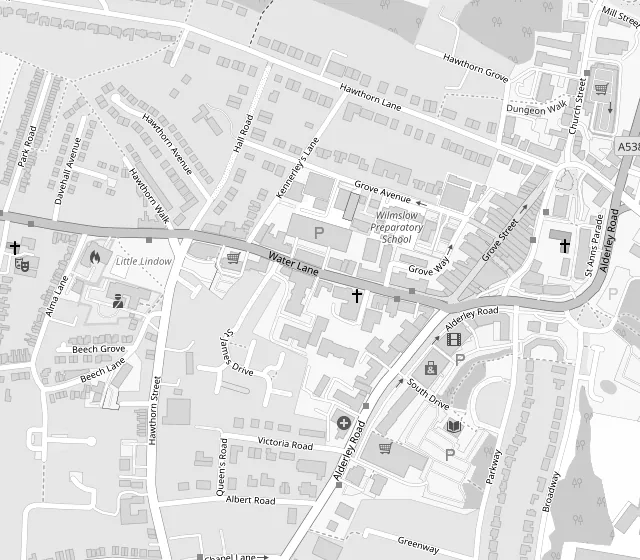
© OpenStreetMap contributors
Need more information?